
GNSS User Technology Report 2018 available for download now!
Disclaimer
This page has been archived and is provided for historical reference purposes only. The content and links are no longer maintained and may now be outdated.
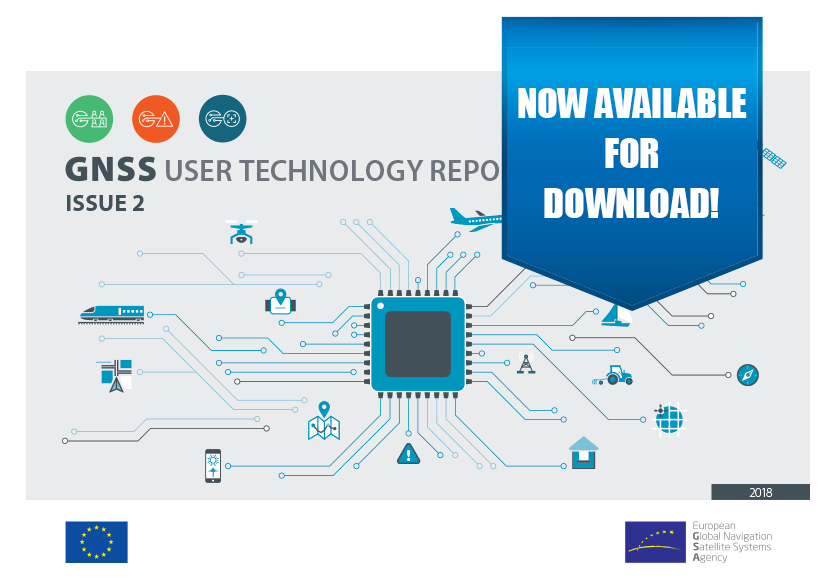
The second edition of the GSA’s GNSS User Technology Report has been published and is now available for free download, providing an exhaustive review of all the latest GNSS trends and developments. Since its launch in 2016, the GNSS User Technology Report has become the go-to-source for information on the dynamic, global GNSS technology industry.
The GNSS User Technology Report, a sister publication to the GSA’s GNSS Market Report, is published every two years and takes an in-depth look at the latest state-of-the-art GNSS receiver technology, along with providing expert analysis on the trends that will shape the global GNSS landscape in the coming years.
Like the inaugural Report in 2016, the second issue focuses on three key macrosegments: mass market solutions; transport safety- and liability-critical solutions; and high precision, timing and asset management solutions. The report opens with an overview of the latest developments and trends in GNSS, with a focus on the multi-constellation and multi-frequency that are driving new trends in the sector.
Important new trend
“With the GNSS User Technology Report, our aim is to provide everybody in the GNSS value chain with a comprehensive overview of the current landscape in the industry and to identify new trends so that stakeholders know in which direction the industry is moving,” GSA Executive Director Carlo des Dorides said, adding: “The most important new trend identified in this issue is the rapid adoption of multiple frequencies, including for consumer devices, as evidenced by the market introduction of the first dual-frequency smartphone in May 2018”.
Read this: GNSS Market Report proves a useful tool across the GNSS market
Some highlights from this year’s report
|
Editor’s special
The final section in this year’s report – the ‘Editor’s special’ section - is dedicated to automation and to the increasingly important role GNSS plays in a number of partially- or fully-automated tasks and functions.
“The most important examples of ambient intelligence and automation are found in the transport domain - driverless cars, autonomous vessels and drones,” says Martin Sunkevic, Market Development Innovation Officer at the GSA in charge of technology monitoring. “It is however important to note that GNSS-based automation applications go well beyond transport. In the report we present examples from all segments.”
“Automation requires secure, ubiquitous and accurate location information for positioning.” said Jean-Pierre Barboux, Project Manager from FDC, which was part of the technology research team at the GSA. “Only thanks to the new generation of positioning systems and omnipresent connectivity we can see this rapid growth of partially and fully automated solutions.”
The analysis of GNSS user technology trends in the Report is supported by testimonials from key suppliers of receiver technology, including: Broadcom, Javad, Kongsberg, Leica, Maxim Integrated, Meinberg, NovAtel, Orolia-Spectracom, Qualcomm, Septentrio, STMicroelectronics, Thales, Trimble and u-blox. In addition, the report includes highlights from around 20 ongoing research projects from the Horizon 2020 and Fundamental Elements programmes aiming at the development of GNSS receiver technology.
The full GNSS User Technology Report 2018 is available for download here.
Media note: This feature can be republished without charge provided the European GNSS Agency (GSA) is acknowledged as the source at the top or the bottom of the story. You must request permission before you use any of the photographs on the site. If you republish, we would be grateful if you could link back to the GSA website (http://www.gsa.europa.eu).