
Eurocontrol and EUSPA Test EGNOS and GNSS for the Future of Drone Operations
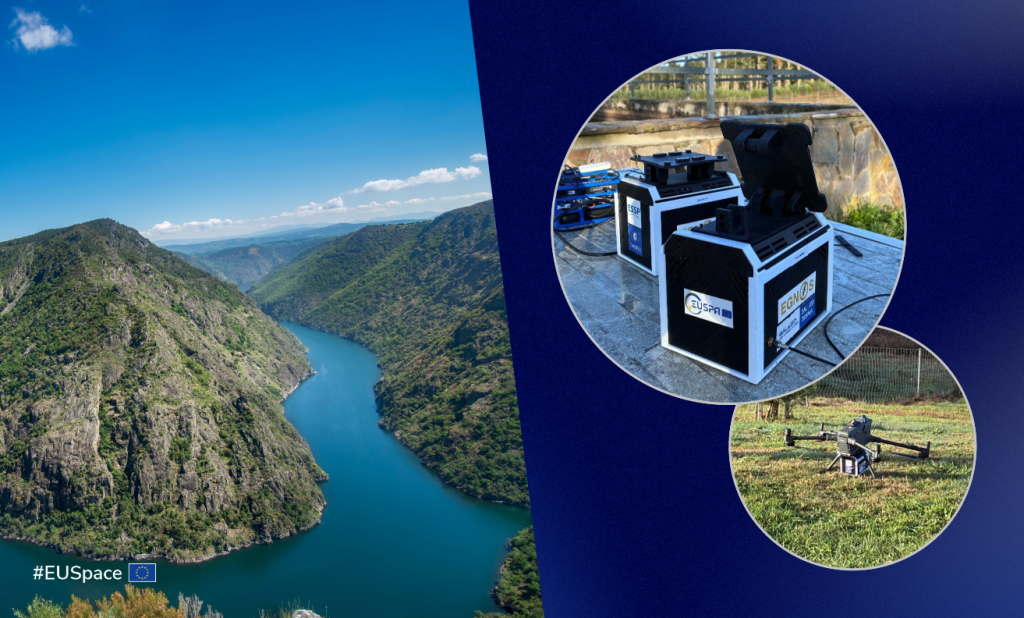
How can Europe’s satellite navigation services support the next generation of drone operations? To answer this question, the European Organisation for the Safety of Air Navigation (EUROCONTROL), with the support of EUSPA and EASA, has launched a series of flight campaigns across Europe to assess the performance of EGNOS, Galileo and related services under real operational conditions.
The first drone flight campaign took place on 20-21 October at the Space for Commercial Innovative Aerial Services (ESCAI) test centre in Ribeira Sacra, Spain. Bringing together national aviation authorities, air navigation service providers, drone operators and GNSS experts, the initiative aims to gather evidence supporting the safe integration of Unmanned Aircraft Systems (UAS), including Beyond Visual Line of Sight (BVLOS) operations.
At the heart of the campaign is the evaluation of European GNSS services in environments representative of future drone operations. Tests were conducted in both open and challenging terrain, enabling participants to assess positioning performance, electronic conspicuity and operational safety under realistic conditions.
A key contribution came from EUSPA, whose mission is to foster the uptake of EU Space services and ensure that user needs are integrated into the evolution of the programmes. Working alongside partners including EUROCONTROL, EASA, National Civil Aviation Authorities (AESA), Air Navigation Service Providers (ENAIRE), ESSP and its GNSS Service Centre (GSC), EUSPA supported the testing of Galileo Open Service, OSNMA, High Accuracy Service (HAS) and EGNOS capabilities in drone applications.
“Safe and scalable drone operations will increasingly rely on robust and trusted positioning, navigation and timing services,” said Carmen Aguilera, EUSPA Operational Market Development Manager. “These campaigns provide valuable operational evidence of how Galileo and EGNOS can support advanced drone missions while helping the European drone ecosystem prepare for future regulatory and operational requirements.”
To support the campaign, the EGNOS service provider, ESSP, developed dedicated GNSS testing equipment together with EUSPA and its GSC, that was installed on board participating drones. The equipment collected positioning data using EGNOS, Galileo OS, OSNMA and HAS services during live flight operations and different flight scenarios. The resulting data will be analysed to assess key GNSS performance indicators such as accuracy, availability, signal quality and positioning reliability.
The tests involved several drone operators, including INECO, Bluenest and Fuvex, while additional organisations carried out demonstrations related to surveillance and electronic conspicuity. Operations were conducted within a dedicated temporary airspace and followed strict safety procedures coordinated with the relevant aviation authorities.
The campaign forms part of a broader Eurocontrol and EUSPA effort to validate innovative air services in real-world environments and support the deployment of U-space services across Europe. By generating operational evidence and fostering collaboration among stakeholders, the initiative contributes to the safe integration of drones into European airspace.
As drone operations continue to expand, Galileo and EGNOS are expected to play an increasingly important role in enabling safe, efficient and resilient navigation services. Through initiatives such as these flight campaigns, EUSPA is helping ensure that European Union’s space technologies remain at the forefront of the rapidly evolving drone market.
Media note: This feature can be republished without charge provided the European Union Agency for the Space Programme (EUSPA) is acknowledged as the source at the top or the bottom of the story. You must request permission before you use any of the photographs on the site. If you republish, we would be grateful if you could link back to the EUSPA website.