
Using Space to Save Lives on Earth
GEXTRECS is an EUSPA Horizon Europe-funded research project1 aimed at demonstrating secure satellite communication services (GOVSATCOM) for extreme crisis scenarios. It directly addresses the European Union’s priority of increasing resilience against both natural and man-made disasters. In large-scale emergencies, when terrestrial infrastructure collapses, secure and interoperable satellite communication becomes essential. GEXTRECS provides end-to-end GOVSATCOM-based solution for first responders, civil protection agencies, and humanitarian missions operating under extreme conditions.
Fostering uptake of GOVSATCOM Initial Services
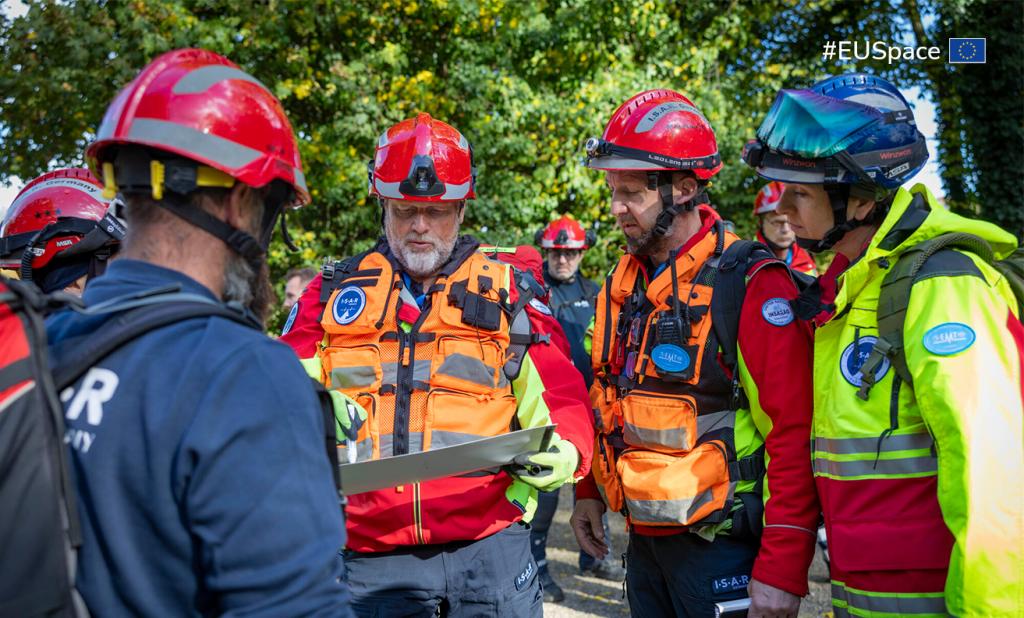
Marking the culmination of GEXTRECS research, a live demonstration on 23 October 2025 featured field operations held simultaneously in Voerde, Germany, and the Port of Vigo, Spain. It was the first event of its kind to showcase synergies across the EU Space Programme components, GOVSATCOM, Copernicus and Galileo.
Following the user-centric approach of EU GOVSATCOM, the GEXTRECS consortium ensured that prospective GOVSATCOM users directly shaped the solutions. This was enabled by the active participation of two partners: I.S.A.R. Germany and CSIC’s Marine Technology Unit (Spain).
GEXTRECS designed an integrated use case for cross-border and maritime response in a large-scale disaster, giving first responders a realistic reference point. It demonstrated how secure services over geostationary satellites can meet emergency communication needs. Participating teams could place video calls, send emails, stream videos, share Earth Observation data, and access precise location information.
GEXTRECS Crisis Management Service Pack
Live demonstration put the GEXTRECS solution to the test in a challenging crisis context. The focus was on:
End-to-End SATCOM service
Emergency responders used secure SATCOM services to coordinate joint action and communicate while performing rescue operations.
Dynamic allocation of limited SATCOM resource
The innovative Dynamic Planner prototype ensured optimal allocation of available satellite communication resources under rapidly changing demands.
Seamless interoperability of communication networks
Network Balancer allowed for the preservation of communications while switching between different SATCOM channels and between satellite and terrestrial communication networks.
Integrated space-based service
The demonstration showcased secure SATCOM deployed to deliver Copernicus Emergency Management Service products and facilitate secure Galileo services. Participating teams received vital positioning information and Earth observation data directly within the crisis response workflow.
The demonstration gave a unique insight into real crisis-response complexity and the central role of reliable communications within the operations. Participants saw, in concrete terms, how GEXTRECS solution improves coordination, efficiency, and safety in emergency management. Results confirmed the integrity and availability of GEXTRECS services, and underscored the added value of integrating GOVSATCOM with Copernicus and Galileo to strengthen situational awareness and operational coordination.
Lessons learnt through user engagement
A Stakeholder Workshop which followed demonstration on 23 October 2025 gathered crisis management and civil protection professionals, representatives of Competent GOVSATCOM Authorities (CGAs), as well as national and EU authorities. It served as a forum to frame the GEXTRECS activities within the EU Space Programme ecosystem and discuss possible policy recommendations to effectively leverage Secure SATCOM for crisis response based on interviews and surveys with crisis-management practitioners and first responders conducted within GEXTRECS.
Simple crisis-time service requests
Seamless activation of End-to-End (GOV)SATCOM services during disaster incidents requires that operational steps to access the services should be minimal and intuitive.
Availability of Rapid Access Kits (RAKs)
Assured connectivity in the first hours of a disaster can be enabled by pre-positioned, ready-to-deploy kits with terminals, auto-pointing systems, batteries, fly-away cases, and crypto modules.
Cyber hygiene by design
End-to-end security makes users part of the cybersecurity responsibility. To decrease the risk and impact of cyberattacks and operator errors, it is important to secure tailored training and embed explicit instructions in existing operational procedures.
Systematic training for users
Just as systematic training and the practice of operational procedures underpin preparedness, there is a need to introduce modules dedicated to SATCOM services. The ultimate goal should be that any responder can establish a satellite link under stress.
Interoperability & standardization in cross-border operations
It is also recommended to establish common procedures & Plug-and-Play solutions in GOVSATCOM. This will help maximize the interoperability of equipment and compliance with standards across different user communities.
Strong engagement in Secure Satcom demonstration
Around 200 participants joined the event, reflecting wide interest from national ministries, civil protection services, police forces and several Competent GOVSATCOM Authorities. The demonstrations showed that practical, hands-on sessions are the most effective way to share operational knowledge and showcase secure satellite communication capabilities.
It also shows how crucial it is to continue advancing secure, reliable satellite communications to support critical missions and emergency response.
1GEXTRECS project has received funding from the European Union’s Horizon Europe Research and Innovation Programme under grant agreement No. 101129626.
Media note: This feature can be republished without charge provided the European Union Agency for the Space Programme (EUSPA) is acknowledged as the source at the top or the bottom of the story. You must request permission before you use any of the photographs on the site. If you republish, we would be grateful if you could link back to the EUSPA website.