

Galileo Open Service Navigation Message Authentication (OSNMA)
-
What is Galileo OSNMA?

-
How does Galileo OSNMA work?

-
Who benefits from Galileo OSNMA?

-
EUSPA’s role

-
Facts and figures

What is Galileo OSNMA?

With GNSS interferences on the rise, malicious actors may jam or spoof signals to provide unreliable or even fake positioning information.
- Jamming floods the radio frequencies used by GNSS with interference signals, effectively blocking the reception of legitimate signals and disrupting navigation and timing computation.
- Spoofing sends fake GNSS signals to mislead receivers, potentially redirecting the trajectory of aircraft, ships or drones.
Galileo OSNMA mitigates the spoofing risk by providing Galileo users with the means to verify that the navigation data they receive comes from the system itself and has not been modified in any way.
How does Galileo OSNMA work?

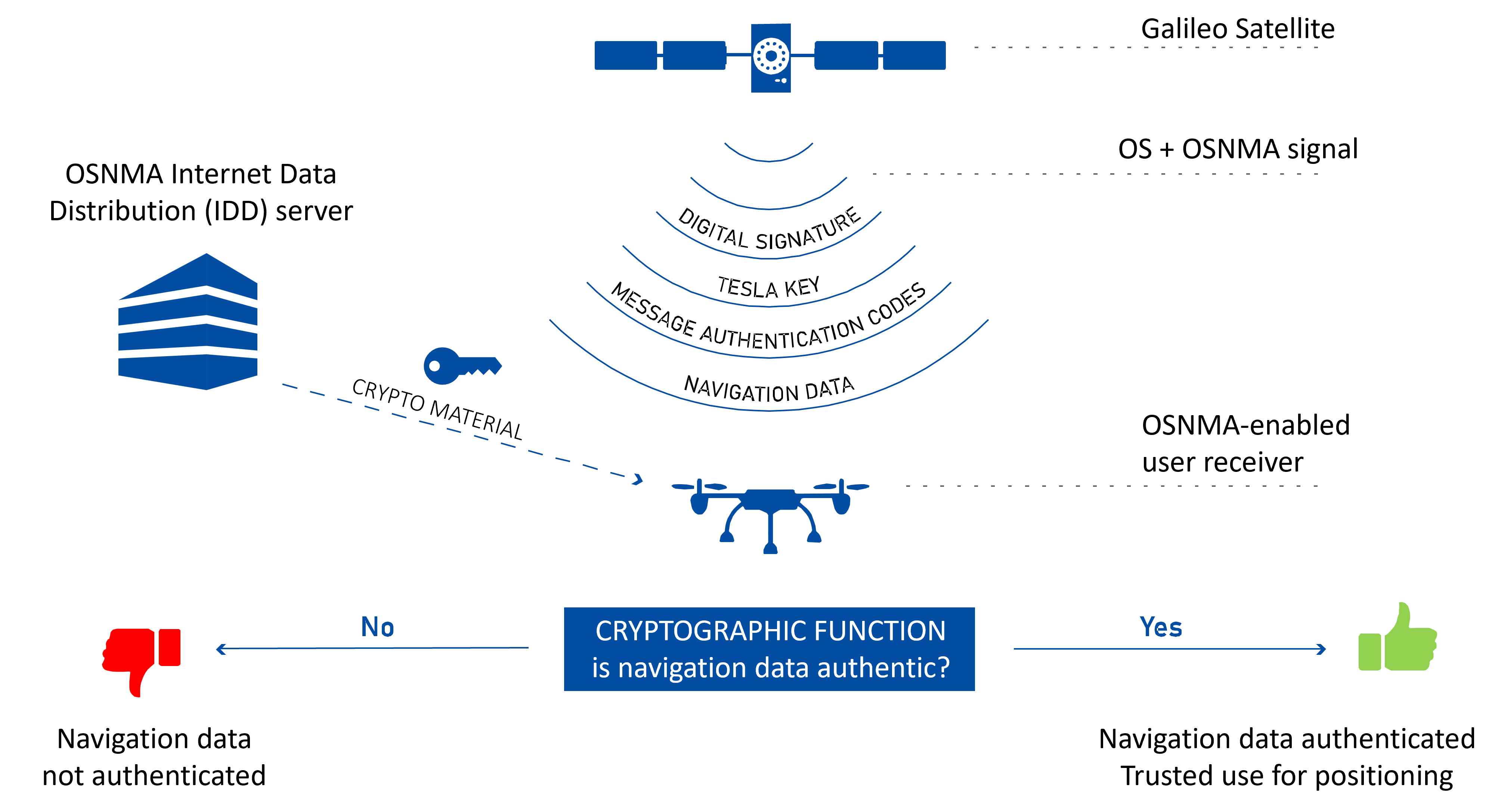
Galileo OSNMA adds a ‘digital signature’ to the Galileo Open Service positioning and timing information broadcast in the signal in space.

Using public keys, an OSNMA-enabled receiver decodes the cryptographic data received from the Galileo satellites and verifies that the navigation data is coming from the Galileo system and not from another source.

Galileo OSNMA also makes Galileo signals unpredictable and difficult to replay, making it more challenging to spoof OSNMA-enabled receivers.

To use OSNMA, receivers need to implement the protocol as described in the public specifications and download the certified public cryptographic material from the GSC and EUSPA websites. Additionally, and to ensure the end-to-end authentication process, an OSNMA-enabled receiver shall implement the requirements and processing steps as specified in the OSNMA receiver guidelines.
Dig deeper:
Galileo OSNMA authenticates data for geolocation information from the Galileo Open Service (I/NAV ephemeris and timing parameters) broadcast on the E1-B signal component. This is done by transmitting authentication-specific data in previously reserved fields of the E1 I/NAV message. By using these fields, OSNMA does not introduce any overhead to the system, thus the OS navigation performance remains untouched.
Who benefits from Galileo OSNMA?
By increasing a receiver’s ability to detect spoofing events, Galileo OSNMA brings an added layer of protection to a wide range of applications:

Agriculture

Rail

Road and automotive

Aviation and drones

Maritime

Space

Emergency management
EUSPA’s role
EUSPA:
- develops and operates the Galileo OSNMA’s infrastructure
- is responsible for the security accreditation of the service
- ensures that the service is delivered with high quality and in alignment with the service commitments as specified in the Service Definition Document (SDD)
- fosters Galileo OSNMA’s adoption across various market segments
Facts and figures

-
Galileo is the first GNSS system to offer protection from spoofing attacks to civilian users globally.
-
The OSNMA Initial Service was declared operational in July 2025.
-
Galileo OSNMA is freely accessible to all users.
-
The service works in challenging environments, such as in urban areas or mountain regions, ensuring that users’ needs are fulfilled in standard operating conditions for the target applications.
-
OSNMA will evolve in the future to provide authentication of additional data broadcast by Galileo (e.g. F/NAV navigation data) and authentication information for GPS broadcast navigation data (L1 C/A). It will also be complemented by the Galileo Signal Authentication Service (SAS) to provide protection at pseudorange level, hence achieving a Galileo fully authenticated positioning solution.