

GNSS for timing and synchronisation
-
What is GNSS timing and synchronisation?

-
How does it work?

-
Benefits of timing and synchronisation

-
Where is it used?

-
EUSPA’s role

What is GNSS timing and synchronisation?

The precise atomic clocks in the Galileo system allow delivery of very accurate timing data to users. The time synchronisation information disseminated in the Galileo SiS is referenced to the Galileo System Time (GST). This information allows Galileo users to estimate their local time referenced to the GST realisation.
The navigation message includes additional parameters which enable users to obtain a realisation of the UTC time by applying a correction to the GST as specified in the Galileo OS SIS ICD. These parameters provide a prediction of GST-UTC based on UTC realisations available at different European metrological institutes.
GNSS receivers use these time signals to synchronise their local clocks with nano-second-level precision, enabling the synchronised operation of systems across wide geographical areas.
How does it work?
The highly stable atomic clocks are continuously monitored by a global network of sensor stations; corrections are computed and uploaded periodically during scheduled uplinks to maintain consistency with GST and UTC.

GNSS satellites broadcast signals that include their precise time and positioning information.

A receiver on Earth uses signals from at least four satellites to calculate its exact position and solve clock bias.

The synchronised, precise time is then distributed to various systems.

GNSS relies on ionospheric models from ground-based monitoring.

Benefits of timing and synchronisation

High accuracy
GNSS provides precise timing down to a few nanoseconds, which is essential for time-sensitive applications.

Global standard
GNSS timing and synchronisation enables globally consistent and traceable timestamps.

Redundancy
Using multiple GNSS constellations improves accuracy and availability.

Regulatory compliance
GNSS timing and synchronisation provides legally traceable and validated timestamps.

Operational efficiency
Synchronised GNSS timing reduces event correlation errors, boosts network reliability (e.g., power grids, 5G), and eliminates manual adjustments for seamless operations.
Where is it used?
The availability of accurate and secure timing information is crucial for a range of critical infrastructures, like telecommunication networks, energy distribution grids and financial markets.

Banks use GNSS equipment for time stamping and to log events chronologically.
Individual stock exchange servers apply time stamps to the trades they execute and to the quotes they establish.


Electricity grids depend on the timing and synchronisation provided by GNSS.
GNSS timing and synchronisation are critical for mobile telecommunication networks.

EUSPA’s role
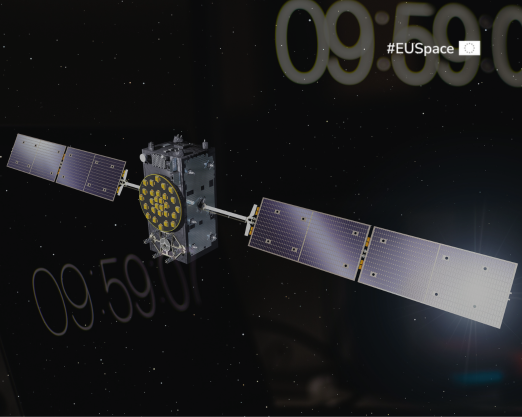
EUSPA supports GNSS timing and synchronisation by ensuring the continuity of services like Galileo and EGNOS.
It also promotes applications that depend on precise timing, supports research into secure synchronisation methods like OSNMA, and engages the user community to ensure services meet timing requirements for critical sectors.
To support emerging user needs, including advanced timing and synchronisation applications, a dedicated Galileo Timing Service is currently under preparation. This service will offer enhanced features for Critical Infrastructure users, including continuous monitoring of timing accuracy to ensure high reliability.