
ASECAP Conference Considers Future Options
Disclaimer
This page has been archived and is provided for historical reference purposes only. The content and links are no longer maintained and may now be outdated.
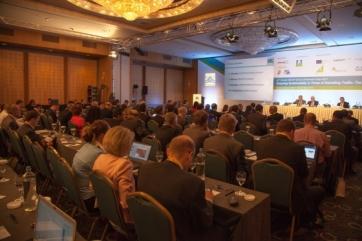
ASECAP road operators share a long-term vision for ever-increasing safety and efficiency and the highest possible quality of service for all road users. Participants at the ASECAP conference in Athens discussed a range of challenging issues as they look to the future.
The Association Européenne des Concessionnaires d’Autoroute et d’Ouvrages à Péages, better known 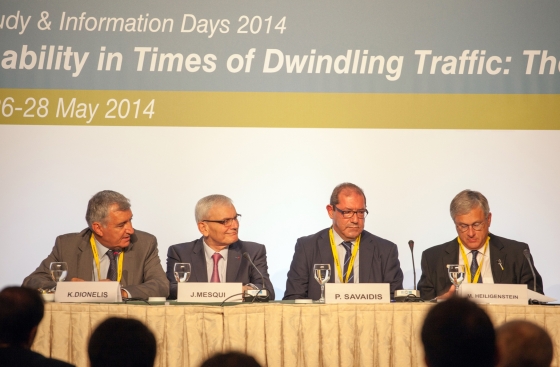 as ASECAP, boasts 16 member countries and five associate member countries, with 187 concessionaires overseeing more than 48,000 km of tolled roads. The networks they operate represent the backbone of efficient movement of goods, services and citizens across the continent.
Speaking at the ASECAP conference in Athens, the Association’s Secretary-General Kallistatos Dionelis said: “We live in a period of crisis, and roads are an important element for economic growth. We are focussing on safety and sustainability, but we are not here to discuss vision – our vision is fixed. We are here to discuss deployment.”
Clearly, moving forward is a priority for ASECAP, including making use of the best possible technological solutions. “We want to use the technologies of today,” said Dionelis.
For the GSA, that means GNSS-based road tolling. European GNSS, starting with EGNOS and soon to include Galileo, now makes it easier than ever to design fairer and more flexible, low-investment road charging solutions based on satellite navigation signals, telling operators who is on a given road, for how long and over what distance with a very high degree of accuracy and reliability.
GNSS represents a powerful potential solution to many of the challenges of today’s road tolling operators, as presented by ASECAP, including the need for flexibility, rapid extensibility, easy and low-cost implementation and interoperability.
Get the Message
Whatever the direction, most now agree that road users must be involved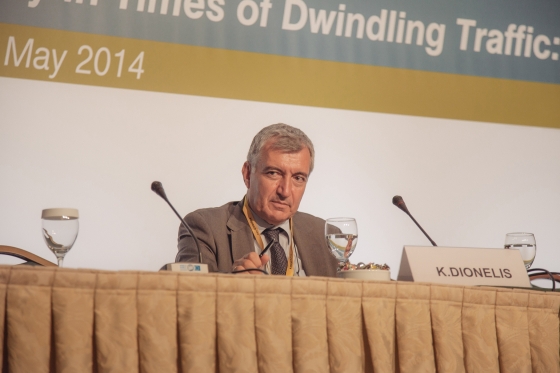 in deciding where we go from here.
Also speaking at the ASECAP conference, IBTTA President Mike Heiligenstein brought the US perspective. Representing the Central Texas Regional Mobility Authority, currently overseeing $12 billion’s worth of road tolling projects, Heiligenstein said an important element for Texas is public outreach, getting the people who use the roads to tell the planners and engineers what they want, before construction even starts. “Without customers, we go broke,” he observed.
But another key issue, he said, is one shared by his European colleagues, that of interoperability: “We have many different electronic toll collection protocols around the US, but achieving interoperability costs money.”
And money does matter. Greek Public Works General-Secretary Stratos Simopoulos painted an alarming picture of what can happen when it dries up. “The economic crisis hit Greece hard,” he said. “We saw a 25% reduction in GDP, unemployment soared and road tolling revenues dropped by 50%. People weren’t driving to work because they had lost their jobs – and those that were driving were finding ways to get out of paying the tolls.”
Now, he said, investors are starting to come back, and the Greek government is working hard to improve relationships between users and road tolling concessionaires to get people back onto the roads as they get back on their feet.
Again, many of the issues raised during the conference lend themselves to GNSS-based road charging solutions. The GSA says it is taking a two-pronged approach when it comes to advancing the cause of GNSS for road charging.
On the one hand, the GSA is working to inform and educate those countries and regions that are just now entering the road tolling arena. These parties, essentially starting from scratch, can chose the kind of tolling system that makes best sense today.
The GSA’s Fiammetta Diani says, “For countries like Belgium that are just now introducing road charging schemes for the first time, they have no ‘legacy’ system to replace. Once they are allowed to weigh the options, the choice is really very simple.”
Belgium has recently announced its decision to use GNSS in its first-ever heavy goods vehicle tolling scheme.
In terms of the total cost of implementation, the GNSS-based solution is much cheaper and much more flexible. GNSS technologies allow operators to modify which road segments are covered, increasing the volume and efficiency of freight transport, virtually instantaneously enlarging charging schemes whenever and if ever required.
Lower costs mean operators can charge less to get more traffic back onto toll roads and/or they can raise more revenues to put towards new road projects, to improve transport services and ultimately benefit the public and the economy.
More so, it makes sense for everyone to choose the same and the best technology, to arrive at an interoperable European standard, so drivers can switch from one road-pricing scheme to another as easily as they ‘roam’ on mobile phone networks across international borders.
Supporting the Future
On the other hand, the GSA is also working with the established operators, 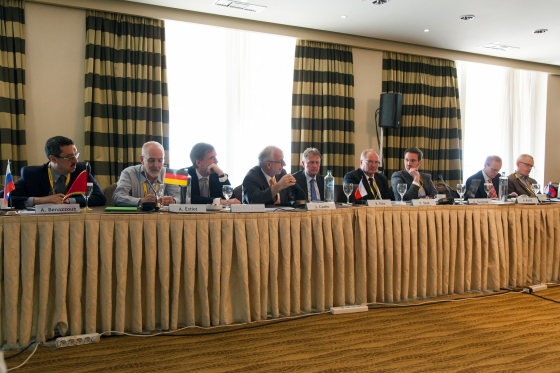 as represented by ASECAP members. For them, adopting a GNSS-based approach is not a question of simply ‘switching over’. It means deconstructing existing and deeply rooted systems, many of which have been built up and evolved progressively over many years and even decades.
Current systems encompass a wide array of often incompatible technologies, from manual toll collection and conventional plaza arrangements to all-electronic toll collection, multi-lane free-flow with radio-based vehicle-to-infrastructure communications, roadside gantry-based systems with cameras that take pictures of license plates, and many others.
For these operators, moving forward means cutting ties, thinking outside the box and embracing radically new ideas and technologies, even as they are in the midst of further developing their current systems.
Diani says the GSA is working closely with ASECAP members, specifically under the ASECAP-GSA Task Force, working to understand how European GNSS technology can bring added value to road infrastructure operators. In many cases, she says, GNSS can be used in combination with existing systems, bringing improvements without necessitating a complete and immediate revolution.
“The main thing is that we are continuing to work together,” says Diani “to identify the best solutions for bringing the road tolling system in Europe into the future.”
-
Fiammetta Diani, GSA
Media note: This feature can be republished without charge provided the European GNSS Agency (GSA) is acknowledged as the source at the top or the bottom of the story. You must request permission before you use any of the photographs on the site. If you republish, we would be grateful if you could link back to the GSA website (http://www.gsa.europa.eu).
More information:
The European GNSS Agency
EGNOS and the Road Sector
ASECAP Days