
Carlo des Dorides Elected to Second Term as GSA Executive Director
Disclaimer
This page has been archived and is provided for historical reference purposes only. The content and links are no longer maintained and may now be outdated.
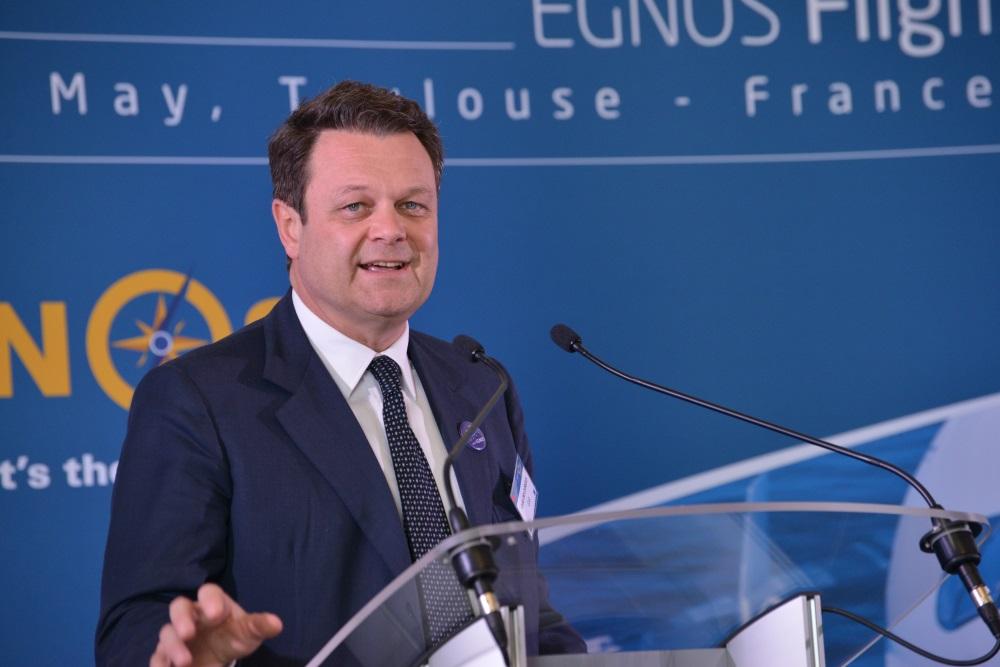
GSA Administrative Board unanimously votes to keep Carlo des Dorides at the helm of Europe’s satellite navigation agency for another four years.
Carlo des Dorides has been re-elected as the Executive Director of the European GNSS Agency (GSA), following a unanimous vote from the GSA Administrative Board held on 30 October. The Board, comprised of representatives of the 28 EU Member States, elected des Dorides to a second four-year term on 29 October 2015. Per EU Regulation 512/2014, each EU member state has one vote, with four votes given to the European Commission.
“My election has a special significance this time. I was first elected following a one-hour interview by the GSA Administrative Board, but this time it was after five years of performance,” says des Dorides. “The next four years will put into practice all that we have been preparing for over the past five years. In 2017, for example, the Agency will be responsible for the service and operations of Galileo as well as EGNOS, where we have been in charge since 2014.”
As Executive Director, des Dorides sets the vision and goals for the GSA. Specifically, he is charged with ensuring the Agency accomplishes its mission of supporting the effective operation, maintenance and security of Europe’s satellite navigation systems, while guaranteeing optimal service levels and developing applications and services that ensure satellite technology benefits end users.
During his first term, des Dorides was focused on building an organisation that will focus on achieving the greatest return on investment for the Europe’s satellite navigation programmes – a goal he will continue to work toward in his second term.
A Space Orientated Career Path
For the past three decades des Dorides has been managing space service teams. In his role prior to Executive Director of the GSA, he held a management role at the European Commission, and was responsible for the definition of the Galileo/EGNOS exploitation phases.
Previously, he led the Concession Department at the European GNSS Supervisory Authority, and served as Chief Negotiator of the Galileo Public-Private-Partnership/Concession contract at the Galileo Joint Undertaking. This in-depth understanding of Galileo and EGNOS, as well as a career in management, helped him excel in his first term as Executive Director.
From a young age, des Dorides was interested in advanced satellite system management. After obtaining a degree in engineering from the University of Rome, he went on to achieve an M.B.A. from CUOA, Vicenza, Italy, and obtained additional education at the International Space University in Toulouse, France. From there, he worked in management in the aerospace sector, including a position as Head of Advanced Telecommunication Programmes and Programme Manager for major satellite telecommunication projects at Alenia Spazio. Later, he served as Director of Programmes and Engineering at ENAV, the Italian air navigation service provider.
Looking Ahead
Today, des Dorides enters a second term as GSA Executive Director in the midst of an exciting time for the GNSS market. There are currently more than 4 billion devices using GNSS services, and that number is expected to triple by 2023. The sector is estimated to grow at more than 8% each year until at least 2019. With all the potential for GNSS – and in particular European GNSS – in the coming four years, the GSA is looking forward to having des Dorides again at the forefront of Europe’s satellite navigation systems.
Media note: This feature can be republished without charge provided the European GNSS Agency (GSA) is acknowledged as the source at the top or the bottom of the story. You must request permission before you use any of the photographs on the site. If you republish, we would be grateful if you could link back to the GSA website (http://www.gsa.europa.eu).