
Contracts to complete Galileo ground segments signed
Disclaimer
This page has been archived and is provided for historical reference purposes only. The content and links are no longer maintained and may now be outdated.
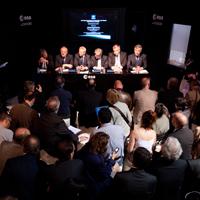
Two contracts, covering work on Galileo ground segments and worth €335 million, have been signed at the European Space Agency (ESA) pavilion of the Paris Air Show at Le Bourget.
 Full house witnesses signings at the ESA pavilion. ©ESA
GALILEO is to be the one and only European global navigation satellite system, expected to boost global markets worth tens of billions of euros annually, as satnav services becomes ubiquitous and more and more consumer devices such as mobile phones feature satnav functionalities.
The signing ceremony on 22 June 2011 was introduced by Laurent Wauquiez, French Minister for Economic Affairs, and Jean-Jacques Dordain, ESA Director General.
"Galileo is a reality–," said Dordain. "this, in spite of the critics and the doubters. We have demonstrated the technological superiority of our European pertnership. We have proven that we can work together and that we are better when we co-operate."
Wauquiez said the event demonstrated Europe's commitment to maintaining a strong space industry and that Galileo would mean independent access for Europe to key satellite navigation services.
'Work package 2', which covers completion of Galileo’s ground mission segment, was signed by Reynald Seznec, CEO of Thales Alenia Space France, and Didier Faivre, ESA Director for Galileo and Navigation-related Activities.
The ground mission segment will generate all the products for supporting navigation services and maintaining their accuracy. It will also forward search and rescue signals detected by the constellation to authorities and disseminate commercial data as part of Galileo’s Commercial Service.
The mission segment system currently in place, which consists of a control centre in Fucino, eight sensor stations on European territory around the world and five similarly distributed uplink stations, is capable of handling the constellation only up to the initial operational phase.
'Work package 3' was signed by Faivre and Colin Paynter, Managing Director of EADS Astrium. This package covers completion of the ground control segment – the network that will monitor and control the satellites and ground elements.
The control segment currently in place consists of a Galileo control centre in Oberpfaffenhofen, Germany and two telemetry, tracking and command facilities in Kourou, French Guiana and Kiruna, Sweden. It is capable of handling a maximum of 18 satellites.
The control centre oversees satellite operations and intervenes as needed, with routine ‘housekeeping’ commands generated automatically along with critical commands from human operators.
In preparation for the Galileo operational phase, a second control centre in Fucino, Italy will be added, as well as two further ground stations in Noumea, New Caledonia and St Denis, Reunion Island.
Racing to completion
Antonio Tajani, European Commission Vice President for Industry and Entrepreneurship said the contract signings were an important milestone for Galileo. "Space can be an important part of the 'third industrial revolution'," he said. "It is about science, it is about technology, but even more, it is about industry, companies, small companies and jobs, and, at the heart of this revolution, the citizen."
Tajani also confirmed the strong support of the European Commission for the timely launch of Galileo operations. "We will have 24 satellites in space by 2014," he pledged. This means 18 satellites originally planned, plus six additional satellites.
Tajani explained, “We now believe the supplemental budget of €1.9 billion which is expected to be requested under the upcoming EU financial perspectives can be reduced to €1.4 billion. That leaves €500 000, with which we can build six additional satellites, thus accelerating the process of reaching operational capacity.”
Europe’s satellite navigation system will begin to take shape in space later this year, with two Galileo satellites slated for lift-off from the ESA spaceport in French Guiana onboard a Soyuz launcher. Subsequently, Tajani explained, new launches will take place at regular intervals until the constellation is complete.