
Detector: Making GNSS Road Applications Even Safer
Disclaimer
This page has been archived and is provided for historical reference purposes only. The content and links are no longer maintained and may now be outdated.
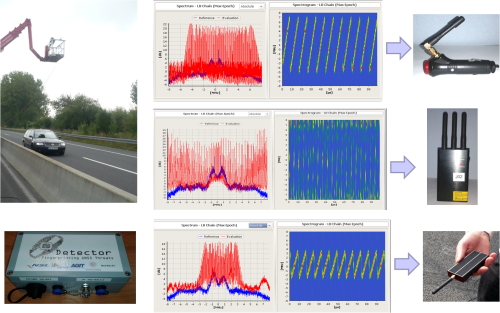
This autumn, the FP7 project DETECTOR confirmed its ability to efficiently detect potential threats to GNSS positioning, timing and velocity.
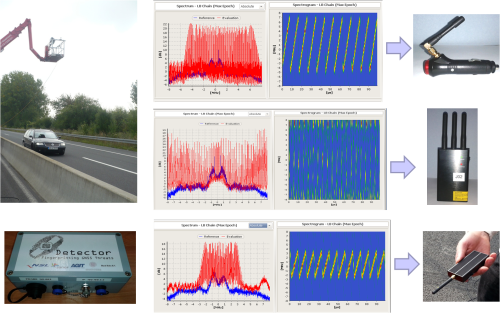 A consistent problem with GNSS services is disruption caused by radio frequency interference (RFI) sources. To mitigate these disruptions, DETECTOR has developed a system to successfully detect, characterise and classify RFI sources.
DETECTOR uses low-cost probes that can be installed along roadsides or other strategic infrastructures and which communicate with a back-office facility. Operating autonomously, the probes continuously monitor the RF spectrum around the GNSS L1 frequency. When RFI is detected, the probes store a sample of raw RF data to perform a preliminary analysis before sending the information to the back office for further automated processing and determination of the type of interference.
As a result, users can quickly determine the likely impact of an interference event, along with differentiating unintentional interference from intentional jamming. In cases of jamming, the system makes it possible to distinguish different jammers, identify multiple detections of the same jammer and trends in the interference threat, and support the development of effective counter-measures.
Successful testing
This end-to-end solution was tested at the Automotive Testing Centre (ATC), located in Aldenhoven, Germany, which has the capacity to safely use jammers in realistic road environments. DETECTOR’s functionality was tested using different jammers and vehicles and by jamming vehicles travelling at different speeds and in different directions. Tests also included placing obstructions between the jammers and the detecting antennas.
In all test scenarios, DETECTOR successfully detected and classified the jammers, with signal characteristics consistent with ‘truth’ samples from laboratory testing. Even the lowest power jammers were detected as soon as they were switched on in vehicles hundreds of metres away from the detection equipment.
Following the testing at ATC, DETECTOR’s capabilities were demonstrated at a September workshop before an audience of over 40 GNSS experts from government, industry and research organisations from across Europe.
Today, DETECTOR probes have been deployed at the Sanef road gantry in northern France, where they provide continuous monitoring of the spectrum and build a database of all interference events. This is a fully-autonomous and robust solution requiring no intervention by a local operator.
The benefits of DETECTOR
 DETECTOR technology benefits EGNOS and Galileo by helping to protect and promote GNSS use, particularly for critical applications. In fact, having knowledge of the interference threat that DETECTOR provides is a key to ensuring resilient GNSS services.
DETECTOR improves the enforcement of existing regulations and supports the development of better RFI regulation. In addition, DETECTOR supports the development of effective counter-measures in user technology and the introduction of more robust operational procedures.
DETECTOR is a joint project of Nottingham Scientific Ltd., Università di Bologna, Sanef, Black Holes B.V. and the Automotive & Rail Innovation Center (ARIC) of AGIT m.b.H. For more details, visit the project website at www.gnss-detector.eu.