
EGNOS and Galileo at ITS Europe 2011
Disclaimer
This page has been archived and is provided for historical reference purposes only. The content and links are no longer maintained and may now be outdated.
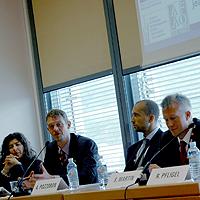
Global Navigation Satellite System (GNSS) technologies have a huge potential to improve road transport, especially when applied to Intelligent Transport Systems (ITS). The European GNSS Agency (GSA) used their presence at the 8th ITS Congress and Exhibition in Lyon, France, to showcase some of the ways this can be achieved.
 Panelists discuss EGNOS and Galileo for ITS in Lyon. ©Hywel Jones
From 6 to 9 June 2011, EGNOS and Galileo were on display at ITS Congress and Exhibition. The GSA stand featured examples of EU-funded GNSS-related projects that focus on ITS, including CoVeL, GINA, GNSSMeter, GSC, PUMA and SCUTUM. Visitors were able to meet coordinators, researchers and industry experts involved in these and other projects.
A new video, presenting the EGNOS system for ITS applications and including many testimonials from the industry was also shown at the stand (see link below for the ‘EGNOS for the Road' video).
GNSS for ITS
The GSA also organised a session on 'Satellite navigation for ITS services' as part of the ITS Europe congress. With the European ITS Directive having come into force in July 2010, this is now more topical than ever.
Stuart Martin, Business Director for Space and Satellite Communications at Logica, pointed out how competitive the market for satellite services is becoming: GPS is being upgraded for safety-of-life services, the Russian Glonass system is nearly at full capacity and China’s Compass/Beidou system will have a full constellation of satellites in 2012.
“But none of these systems was designed for road transport,” he pointed out. GPS was designed for military use, for example, while EGNOS is being used primarily for aviation.
Logica has therefore joined a project called the Multi-constellation Regional System Land Users Testbed (MLUTB) which aims to demonstrate the viability of GNSS for “high integrity, high reliability and high liability applications” such as road-user charging or emergency services.
In safety-critical situations, or where legal decisions must be based on GNSS, services cannot rely on the map-matching techniques currently used, he said. Such applications need 'proof-of-position services' (POPS) that provide a 'confidence level' signal, which assures the operator that a given vehicle is within a circle of defined radius.
Advantages in working together more closely
Alessandro Pozzobon, a Project Manager at Qascom, Italy, presented some solutions to these challenges currently being studied by the PUMA project. The project’s system compares GNSS data against sensor information from the vehicle, performing dead-reckoning calculations to confirm location and ensuring that positioning is more robust against interferences and attacks.
“GNSS certainly has some advantages for road-charging schemes,” said Pozzobon. It offers interoperability at national and European levels, can easily integrate new services and requires no physical infrastructure on the ground.
New services and technologies are needed to put road users in focus, according to Rasmus Lindholm, the Head of Partnership Services for ERTICO – ITS Europe. He said, “my key message is that we need co-operation between our two industries, which don’t work together enough as yet.”
ERTICO is leading the GSC project, investigating the potential of EGNOS and Galileo to enable a new market for GNSS services in road transport. “The ITS industry needs to dig into the GNSS signals to see what they can do,” said Lindholm, while, “the Satellite Navigation industry needs to ask the road industry ‘what do you need?’” He recommended that the European Commission and GSA make a specific effort to bring together the ITS and GNSS communities, and to create a culture of EGNOS and Galileo within industry and among users, just as the GSC project had helped to do.
Using EGNOS to improve road safety
Jean-Philippe Mechin is a Project Manager with the French Ministry for Transport and Sustainable Development’s (MEDDTL) task force on Satellite Navigation and Telecommunications at the Centre d’Études Techniques de L’Équipement (CETE) du Sud-Ouest. He described the French government-funded SERPE project which uses GPS with EGNOS for location services and can be used for the analysis of traffic accident blackspots.
“We need co-operation between industry, standardisation and policy makers,” said Irene Fusco, a Project Manager with the European Road Federation (ERF). She briefly presented the SCUTUM project, which is working on a system for using EGNOS in the transport of dangerous goods by road, and which could help Member States in implementing the ITS Directive.
Fusco also emphasised the project’s synergies with other national and international policies, and the importance of assembling a project consortium that includes industry, research, ministries and standardisation bodies. This SCUTUM approach – keeping in line with EU policy, involving policy-makers and using standardisation – can be applied to other road applications for EGNOS.
In summing up, participants in the session agreed that the ITS and GNSS industries need to communicate and work together more closely. Projects that involve partners from both industries seem to hold a lot of potential for doing this.
More information:
'EGNOS for the Road' video : watch