
EGNOS now a key selling point in business aviation sector
Disclaimer
This page has been archived and is provided for historical reference purposes only. The content and links are no longer maintained and may now be outdated.
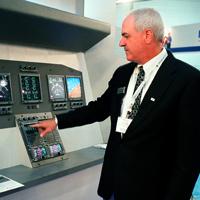
At this year's European Business Aviation Convention and Exibition (EBACE 2011) in Geneva, leading aircraft and equipment manufacturers embraced the EGNOS message: 'It's here, use it'.
Speaking in Geneva, Dan Reida of Universal Avionics said his company's latest flight management systems are ready to use EGNOS, and while this may not be news in itself, as virtually all new avionics systems are EGNOS-compatible, Universal is actually highlighting this readiness as a key marketing message.
"We've witnessed the tremendous benefits for aviation of the WAAS system in the United States and we see no reason to believe that EGNOS will not have a similar impact in Europe." Says Reida, Universal has managed to increase its market share in the US by advertising its use of WAAS to improve GPS accuracy.
What is EGNOS?
Like the WAAS (Wide Area Augmentation System) in the USA, EGNOS (European Geostationary Navigation Overlay Service) augments existing satellite navigation signals such as GPS and makes them suitable for safety-critical applications such as flying aircraft.
 Dan Reida. ©Peter Gutierrez
"The benefits of an augmentation system like EGNOS are too great to ignore," said Reida." The extra accuracy it delivers is an essential advantage to today's business aviators. We have a large customer base here in Europe and we intend to do everything we can to support that base, and we believe EGNOS is going to be an important demand in the very near future."
Universal put its money where its mouth was at EBACE 2011, buying a front page ad in Aviation Week's BCA Show News that proclaimed 'Welcome to EGNOS'.
Gathering momentum
Hans de With of the European GNSS Agency (GSA) said traffic at the EGNOS stand was steady and enthusiastic at this year's EBACE exhibition. "People here want to know three things: Is EGNOS ready? What airports have it? and, How can I get it?"
The GSA is the EU agency charged, among other things, with promoting EGNOS, whose critical 'Safety of Life' or 'SoL' signal was recently certified for civil aviation. With the new 'Accepta' project, managed by the GSA, the EU is helping to fund the publication of EGNOS-based landing procedures at airports across Europe, and to equip aircraft to fly these procedures.
"A very big part of our target audience is here at EBACE," said de With, "and that's why it's so important for us to be here to deliver our message about EGNOS and aviation."
Airplane manufacturers are also catching on to the potential impact of EGNOS, for aviation but also for their own bottom lines. Fred Muggli of Pilatus said, "Everything is going in this direction. Augmentation systems such as WAAS and EGNOS represent the latest and greatest in aviation technologies and that's what we want to deliver to our customers."
Europe leading the way
Established in 1939, Pilatus Aircraft Ltd is now the world’s leading manufacturer of single-engine turboprop aircraft and the only Swiss company to develop, build and sell aircraft and training systems on every continent.
The Pilatus PC 12NG turboprop aircraft boasts special features, including robust landing gear, that allow it to fly into some of the most remote and least well-equipped airports, explained Muggli, precisely the kind of airports served best by EGNOS. "With this kind of satellite navigation system in this kind of aircraft," he stated, "our customers can enjoy safer and more efficient door-to-door air transport under the most demanding conditions, and that's exactly what we are telling them."
Wider significance
EBACE is a premier event for the European business aviation community, bringing together all manner of people involved in nearly all aspects of the sector. This year, it also served as a platform for the EU's high-profile 'SESAR' programme, which is aimed at modernising Europe's air traffic management system.
Speaking at a special meeting, Bob Graham, Head of SESAR Concept Strategy and Development, underlined the key role of satellite navigation in the future air traffic management system. "We will be transitioning to a much more satnav-oriented approach, just as our colleagues in the US are doing with the 'NextGen' initiative. This means greater safety and more predictability in terms of aircraft location."
Dassault's Serge Lebourg also cited EGNOS. "We at Dassault are very pleased to have been involved in some of the first EGNOS-based flight tests. We are absolutely convinced of the importance of EGNOS for air traffic management and for the business aviation sector in particular, and we will continue to push for its rapid adoption."
More information: