
ESNC 2011 launch
Disclaimer
This page has been archived and is provided for historical reference purposes only. The content and links are no longer maintained and may now be outdated.
The European Satellite Navigation Competition (ESNC) is going from strength to strength, with new regional partners, new prizes and a palpable sense that 2011 will be a big year for the satnav community following the recent operational launch of EGNOS services for aviation.
 Inmarsat welcomes ESNC London launch. ©Christian Nielson
What started in 2004 as a Bavarian government-backed prize with 14 entries from three partner regions has blossomed into a global competition involving hundreds of applicants from more than 20 partner regions. The 2011 edition marks the addition of four new eastern European partners – Estonia, Latvia, Macedonia and Medjimurje (Croatia) – and Catalonia.
ESNC’s mission is to encourage the development of market-driven applications based on satellite navigation technology and initiatives, including the European global navigation satellite systems (GNSS) and Galileo, once fully operational. Around €100 000 in cash prizes and €1 million in start-up support are up for grabs.
Buoyed by EGNOS’ operational launch for aviation in March of this year and several key regulatory and technical milestones achieved late last year, the European GNSS Agency (GSA) is clearly on a new course in 2011. “EGNOS opens the door to a new era for innovative products and services that harness the increased accuracy and reliability of the system,” noted the GSA’s new Executive Director Carlo des Dorides ahead of ESNC’s launch meeting in London on 11 May. “EGNOS is now fully available, free of charge and here to stay,” stressed GSA’s Head of Communication, Donna Reay. “So use it!”
Big year for EGNOS
It’s no understatement to say that 2011 is a big year for European satellite navigation and services. Headline news in March was that EGNOS is “fully operational for civil aviation”. This is a major milestone, capping off some 14 years of planning and preparations. It means EGNOS’ ‘Safety-Of-Life-Service’ – a free application which provides a near real-time integrity message warning users of signal loss or malfunction – is here to stay. This news opens the door to a new era of innovative products and services drawing on the greater accuracy and reliability underwritten by EGNOS.
The challenge ahead for GSA, according to des Dorides, will be to raise awareness among potential users and developers about EGNOS’ strengths, especially in the security domain, and to support accreditation and further market analysis of the system. “It’s important that we get closer to the users to explain EGNOS’ capabilities,” he said.
He believes the EU’s research Framework Programmes and projects also play a role in EGNOS’ future. And he underscored the GSA’s commitment to the ESNC as a conduit for achieving greater awareness across the board of Europe’s satnav achievements.
Winning ideas
The GSA co-supports the competition’s top prize, the Galileo Masters, alongside competition organiser, Germany’s Anwendungszentrum GmbH Oberpfaffenhofen (AZO). According to AZO’s Managing Director Thorsten Rudolph, the prize offers a unique chance to pitch, present and promote truly innovative satellite navigation ideas to industry leaders, with a view to developing them into prototypes and eventually, with the right investment and support, market ready products and services.
“No matter whether you are an individual or a team from a company, research institute or start-up, what counts is your idea,” he noted. “We are looking for applications based on satellite navigation that use the technology in a new and innovative way.”
Since the prize’s launch, there have been around 80 laureates and a survey revealed that some 76% of them have realised their ideas or are moving steadily in that direction. A further 30% have patents to their name, with incubators playing a key role in helping them reach their goals, according to AZO. In terms of participants in the competition to date, 32% have been individuals, 23% start-ups, 15% SMEs. Universities and research institutes have accounted for 12% each and large enterprises only 6%.
Ideas are evaluated according to their:
- Benefits, especially compared to existing solutions;
- Technical feasibility;
- GNSS significance;
- Market appeal;
- Patentability;
- Legal risks;
- Investment potential; and
- Degree of innovation.
Got an idea for a killer app, innovative technology or quirky new way of using satellite navigation? The European Satellite Navigation Competition ‘Ideas Database’ is open for submissions, so register yourself, your team or organisation.
The deadline for applications is 30 June 2011!
More information: www.galileo-masters.eu
Special prizes, international cross-over
The GSA also sponsors one of eight Special Topic prizes focused on finding ‘The most promising EGNOS application idea’. Winning ideas, according to GSA’s Donna Reay, not only have to be original but also show unique uses of EGNOS features, while having business and social benefits or potential, with a credible team behind them. “The winner of our prize is awarded up to 12 months access to an EU-based incubation centre of their choice in order to further develop their winning concept.”
The international flavour of the ESNC was evident at the launch, with delegates attending from Africa, Asia and all over Europe. The addition of new sponsors, particular the certification specialists TÜV SÜD, as well as new partners, prizes and features promises to attract more industry and media attention to the annual ESNC competition.
The new prize, called Galileo Pro, is being organised by Taiwan’s Industrial Technology Research Institute (ITRI) to promote the design and implementation of innovative GNSS-inspired prototypes supporting ‘connected vehicles’, including car-to-car and car-to-roadside infrastructure applications. Taiwan is a global powerhouse in microchips and electronics, including satnav hardware. In 2010, 86% of the world’s portable navigation devices were designed and mostly manufactured in Taiwan. And ITRI plays a major role in the small island’s innovation output with some 65 spin-offs and 163 incubators in its orbit.
Other special prizes under the ESNC umbrella include the ‘ESA Innovation Prize’ which looks for ideas that can be implemented fast and with high profit potential, and a prize given by the DLR in Germany that rewards new augmented navigation ideas. Map specialists Navteq are sponsoring commercial ideas for mobile enterprise solutions and a university challenge aimed at tapping into the younger generations who, according to Navteq’s Pia Vuohelainen, have their fingers on the pulse of the latest trends in location-based services and social networking.
“We’re really involved in a big adventure here,” commented Michel Bosco, representing the European Commission’s Energy and Transport DG. Those in the Galileo community are accustomed to long lifecycles in realising such huge infrastructure projects, he suggested, which is why the meteoric rise of ESNC “should be applauded”, he said.
But he concluded that more work is still needed to help citizens and business realise the potential of this valuable infrastructure and investment: “We must not miss this opportunity in terms of the socio-economic benefits.”
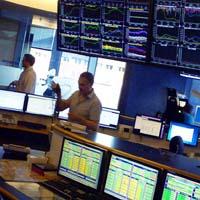
Mission control – On the eve of the ESNC 2011 kick-off in London, delegates were treated to a guided tour of Inmarsat’s satellite control rooms.
Inmarsat is the market leader in end-to-end mobile satellite navigation services, with the majority of its 300 000-plus direct customers in the military, maritime and aviation sectors. Hidden deep inside it’s spacious headquarters overlooking London’s ‘Old Street’ underground station, a remarkable assembly of complex machinery, control terminals and advanced technologies acts as the central nervous system of a vast network of satellites and satnav customers.
In a fish tank-like auditorium perched between the network operations room and satellite control room, Ruy Pinto, Inmarsat’s Vice President of Satellite and Network Operations, shared with delegates insights into the precision-perfect world of satellite communications. As he spoke, colourfully lit overhead charts in the control rooms provided an unearthly backdrop, tracking satellites, providing status readouts and plotting real-time traffic and positions of Inmarsat users logging in and out of the network.
Today, the control systems are largely automated, but experts are on hand or on call 24/7 in case things go wrong or anomalies warrant investigation.
“We watch BBC and CNN too,” Pinto told the audience. “When events like the tsunami in Japan or the disaster in Haiti happen, we need to be ready,” because these events bring sudden sharp peaks in demands from emergency crews and other first-responders. Major media outlets have even been know to call Inmarsat directly to be sure they will get the best quality satnav link-ups for their broadcasts and reports on the ground.
Preparation and pinpoint accuracy are critical because the safety of transport systems, the accuracy of location systems, and the reliability of satellite-based services that the world increasingly relies on are at stake.