
European GNSS in Action: A New Way to be Adventurous
Disclaimer
This page has been archived and is provided for historical reference purposes only. The content and links are no longer maintained and may now be outdated.
New GSA video profiles how European GNSS powered Location Based Services help users better explore the great outdoors.
Navigation systems have long been popular in cars and on mobile phones, helping people find their way from point A to point B. But outside of well-travelled roads, these systems are lacking. In hard to reach areas like nature trails and mountain passes, GPS signals simply aren’t strong enough for accurate navigation.
Now, with the introduction of Galileo and a new app made specifically for outdoor navigation, all of this is changing.
A New Way to Get Outdoors
Komoot is an outdoor app for activity and exploration, guiding users even in untraveled terrain. The innovative app will use precise positioning provided by Galileo to give users turn-by-turn offline navigation and direct routes. “Even if you’re mountain biking in the forest, you can get directions,” says Markus Hallermann, Komoot’s Co-Founder and CEO.
The app, which was founded in 2010, also offers hikers and cyclists topographic maps and recommendations based on user-generated content.
Read This: Location Based Services Market Report
This recommendation feature allows users to highlight their favourite sights, single tracks, peaks, or other locations on a trail and flag them for other users. “People discover their home surroundings in a new way,” says Hallermann, noting that most people follow the same paths over and over, but with Komoot are empowered to discover new trails without worrying about getting lost. “For our users, it’s really important to have robust and accurate positioning when they’re out in the forest in order to stay safe,” he says.
Galileo Enhanced
This is where Galileo will come in. With the addition of more satellites to the existing constellation, receivers like those in mobile phones will be able to benefit from improved accuracy and reliability, even in fjords, mountains, and other remote areas. Hallermann says the increased number of satellites mean users will always know where they’re going – giving them more freedom to be adventurous.
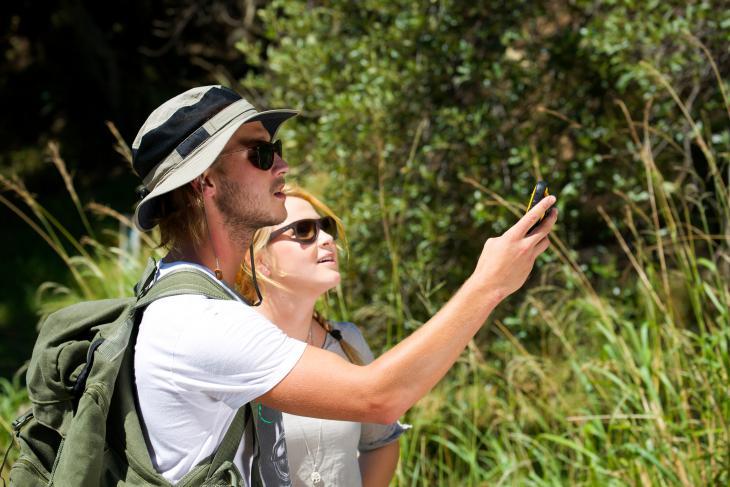
Galileo will also help with other features, like learning more about your surroundings. With Komoot, users can point their phone at a specific mountain peak and learn its name, elevation, and distance within seconds.
Through providing a safe, reliable navigation app with interactive features like highlights and photo and tip sharing, Komoot hopes to change the way people explore the outdoors. “Our vision is to enable everyone to have outdoor experiences in their life, everywhere, with just one tap,” says Hallermann.
Komoot is just one example of the many apps sets to benefit from Galileo. To learn more about these Galileo-enabled Location Based Services, be sure to check out the new GSA video here.
More Information
Media note: This feature can be republished without charge provided the European GNSS Agency (GSA) is acknowledged as the source at the top or the bottom of the story. You must request permission before you use any of the photographs on the site. If you republish, we would be grateful if you could link back to the GSA website (http://www.gsa.europa.eu).