
Galileo bringing added value to ITS all around the World
Disclaimer
This page has been archived and is provided for historical reference purposes only. The content and links are no longer maintained and may now be outdated.
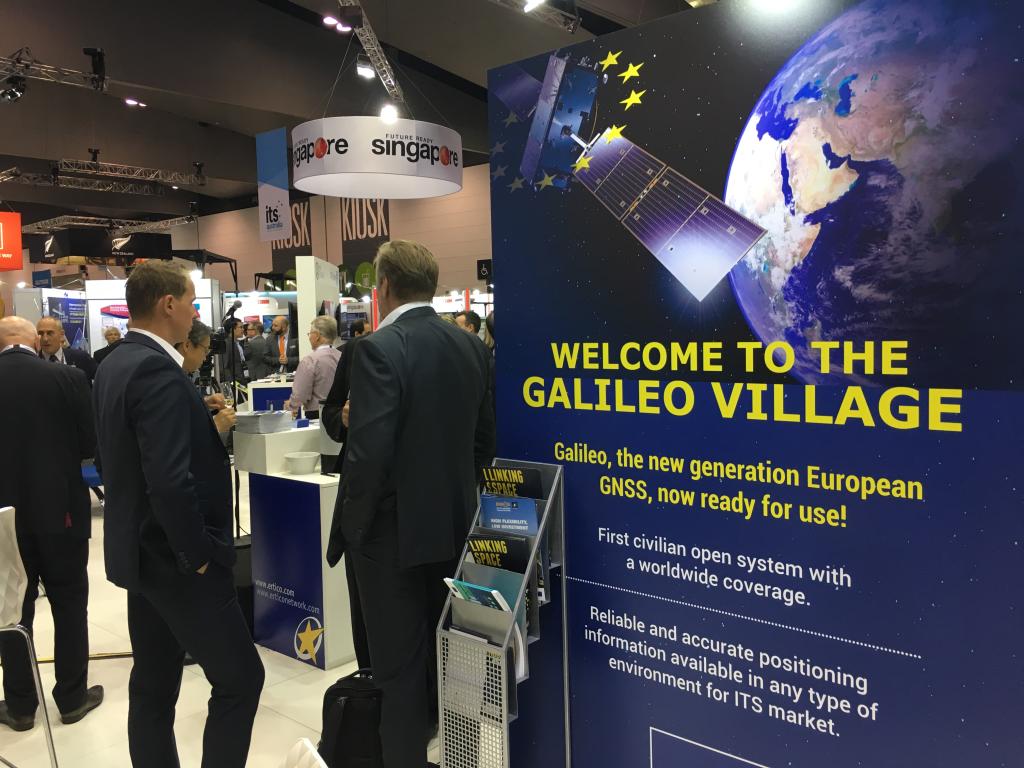
At this year’s ITS World Congress in Melbourne, Australia, the European GNSS Agency (GSA) demonstrated the added value that Galileo will bring to intelligent transportation systems, starting with the declaration of Galileo Initial Services later this year.
Galileo took to the global stage at the recent World Congress on Intelligent Transport Systems (ITS) in Melbourne, Australia. In the lead up to the declaration of Galileo Initial Services later this year, the GSA used the Galileo Village to showcase the programme’s many ITS-related benefits. The stand was organised in conjunction with the Joint European Project for International ITS/EGNSS awareness raising, also known as JUPITER, a Horizon 2020 supported project.
“The goal was to both highlight the many benefits that Galileo will soon offer the ITS sector and to catalyse resources, investments and partnerships, particularly in the Asia Pacific Region, to scale up and really maximise the citizen’s return on investment,” says GSA Officer Alberto Fernández Wyttenbach.
Introducing Galileo to the ITS market
Through project demonstrations and presentations, the GSA showed how public stakeholders and actors in the transportation fields stand to benefit from the improved positioning and navigation performance that Galileo offers. “With the Declaration of Galileo Initial Services just several months away, the Galileo Village is a unique opportunity for the JUPITER Project to truly introduce the programme to the ITS market and the Asia Pacific region,” says project coordinator Hanna-Kaisa Saari. “Through these demonstrations and interactions, we were able to directly show visitors the value that Galileo brings to this sector.”
One SME on display at the Village, M3 Systems, specialises in navigation studies, technologies and applications that require accuracy, availability and integrity. As to Galileo, the company is helping define and study Galileo signals and develop performance enhancing algorithms for receivers. One of these, the GNSS Simulator StellaNGC, allows for accurate testing so a user can easily verify positioning performance under varied conditions – of vital importance for companies looking to bring accurate GNSS products to market.
NSL, another British company exhibiting at the Village, are pioneers in the use of European GNSS technologies within the critical markets that directly affect the safety of citizens, national security and the way business is conducted. The company delivers a range of GNSS-based services, systems, solutions and research to ensure one’s positioning and navigation is accurate, reliable, safe and secure. On display at the Village was the company’s DETECTOR product, a GNSS interference detection and characterisation system. By using DETECTOR, GNSS developers and service regulators can test their systems in the presence of captured interferences.
In addition to JUPITER, two other GSA-supported projects were exhibiting at the Village: GNSS.asia and INLANE. GNSS.asia is dedicated to developing and implementing GNSS industrial cooperation between European and Asia Pacific GNSS industries, with a focus on the downstream sector. “Industrial collaboration within the international context of the GNSS downstream sector is becoming increasingly important, particularly as Galileo moves towards operational readiness,” says project coordinator Rainer Horn.
The INLANE project, on the other hand, is focusing on the prospective autonomous vehicle industry. According to the project, the launch of Galileo Initial Services will be a major step towards achieving the level of accuracy and reliability needed to make the autonomous vehicle a reality. “Galileo will provide a stronger service that is more resistant to multipath interference in urban canyons, along with an authenticated signal capable of detecting spoofing attacks – both absolute musts for the safe operation of autonomous cars,” says project coordinator Oihana Otaegui. In this line, the project is working to fuse computer vision with GNSS technologies via dynamic maps that are updated in real time via cloud crowdsourcing techniques. The project’s products were also featured at the Honda and TomTom booths.
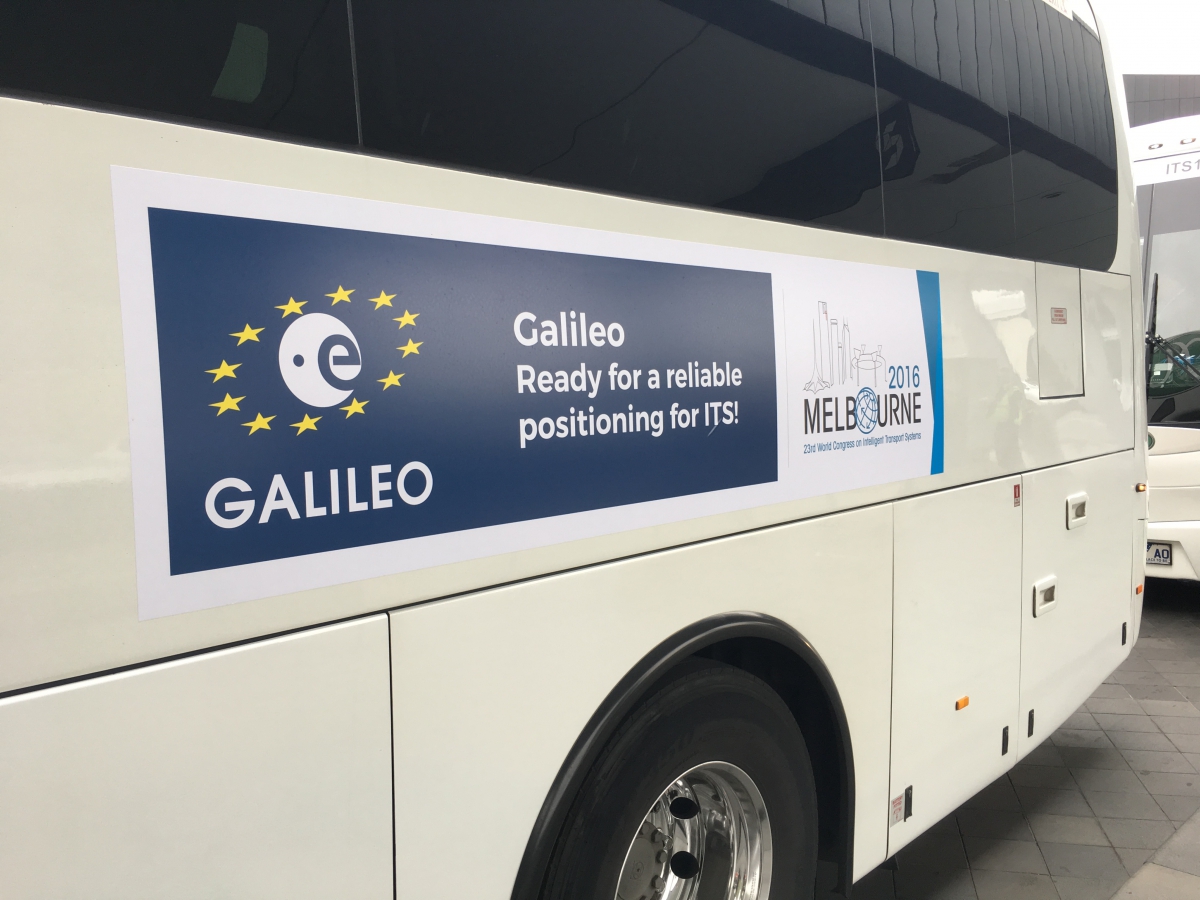
A ride on the Galileo Bus
Beyond the Galileo Village, the ITS World Congress also featured live demonstrations of Galileo’s improved performance. Delegates were able to catch a ride on the Galileo Bus to shuttle back and forth from the event venue to the Albert Park Demo Precinct. The bus was equipped with a Galileo enabled receiver and a Controlled Reception Pattern Antenna (CRPA) that removes the negative impact that signal reflections has on GNSS positioning within an urban environment. The benefits of using Galileo to determine the position of the bus in real time were experienced by around 500 international delegates.
Media note: This feature can be republished without charge provided the European GNSS Agency (GSA) is acknowledged as the source at the top or the bottom of the story. You must request permission before you use any of the photographs on the site. If you republish, we would be grateful if you could link back to the GSA website (http://www.gsa.europa.eu).