GSA Talks Space Policy in Bavaria
Disclaimer
This page has been archived and is provided for historical reference purposes only. The content and links are no longer maintained and may now be outdated.
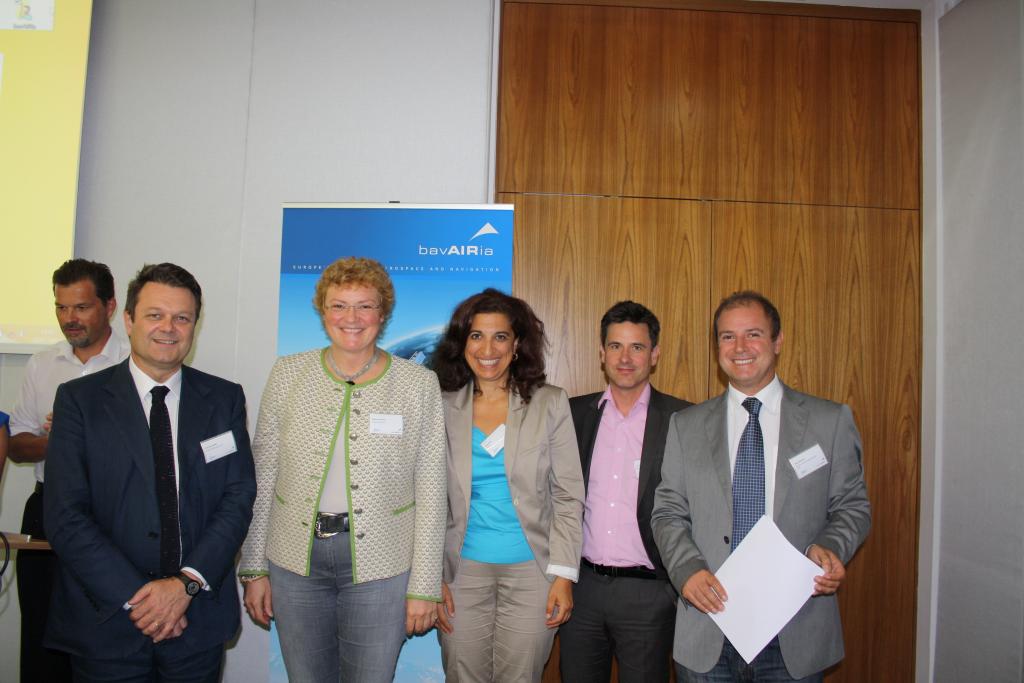
The European GNSS Agency participated in the Space Policy Industry Dialogue, sponsored by NEREUS, on 24 July 2015, taking the opportunity to stress the importance of the end user.
Recently, the GSA joined the European Space community at the NEREUS (Network of European Regions Using Space Technologies) sponsored Space Policy Industry Dialogue, held in Augsburg (Germany). The Agency took advantage of the event to stress the importance of the end user.
At the event, GSA Executive Director Carlo des Dorides joined EOMAP CEO Thomas Heege, Planetek/Apulian Aerospace District’s Paolo Manunta and MEP Monika Hohlmeier for a panel discussion. “Service means giving the user something he or she needs,” said GSA Executive Director Carlo des Dorides. “This is exactly where space based services should start from, the user. Only when we understand the users´ needs are we able to create the best value.”
Also Read: Promoting the value of space to the Regions
Des Dorides went on to say that the GSA is working to place the user at the centre of a complex stage that includes many players, including the European Commission, European Parliament, Member States, ESA, and more.
His comments were fitting with the theme of the event, which was to learn about expectations, barriers, and the future roadmap of space in Europe – as well as connect the space industry with politics and agencies for an open discussion on the future of the sector.
The Role of Research and Infrastructure
According to des Dorides, in order to create a culture of placing the user first, there should be a switch from an infrastructure-driven approach to a user-driven one. To achieve this, the GSA is working to connect industry with politics and space infrastructure.
One example of how the GSA is accomplishing this is the Horizon 2020 research programme, which aims to foster innovation. Each project in the programme requires a business plan, which des Dorides said helps ensure market success. “As SMEs are especially important for innovation, there is one topic within H2020 targeting these. This funding scheme has been designed specifically for single or groups of highly innovative SMEs with international ambitions, determined to turn strong, innovative business ideas into winners on the market,” he said. “The aim is to cover full-cycle business innovation support from conception and planning to business plan execution and demonstration, preparing the way towards commercialisation.”
Moving to products, des Dorides emphasised the need for infrastructure as a basis for services. As an example, he noted how EGNOS is already fully operational and Galileo Initial Services will be declared in 2016.
This need for infrastructure and innovation is a sentiment shared by Monika Hohlmeier, Member of the European Parliament and Chair of the Sky and Space Intergroup, who noted that innovation and growth comes from research and not just infrastructure. “Research also means high-risk funding for start-ups and entrepreneurship,” she said. “In order for Europe to remain a competitive aerospace sector, our European budgets will have to accommodate risks. The same is true for the various downstream application segments.”
Des Dorides agreed, saying that Europe’s policy makers should balance the market with regulatory needs. “Where strategic European values are at stake, the European Commission needs to foster these with regulatory aid,” he said.
To achieve market stimulation, des Dorides called on Member States to act and introduced an initiative called Getting Closer to the Member States to help the GSA work more closely with partners. The initiative involves a survey to understand specific Member State interests, a bilateral workshop to mutually understand both parties’ needs, and an action plan to multiply national measures by European GSA tasks.
In conclusion, des Dorides noted that there are challenges going forward, including funding, awareness and partnership. “Especially for smaller companies, it is important to know who can provide experience, know-how and market access,” he said.
Bavaria is one of the GSA’s most important partners. ASPHALT, PUMA, STON, and SX5 were FP7 projects enjoying great success, while E-KnoT, COREGAL, ERSAT EAV, FOSTERITS, GNSS.asia2, LARA, PARADISE, POSITION, and e-Airport are Bavarian participants successfully working under the H2020 initiative.
ASPHALT – An advanced Galileo navigation system for asphalt fleet machines
- Asphalt Truck Terminal
- Paver Steering (algorithms and concept for integration in paver)
- Levelling System (includes thickness and evenness measurement)
- Paver Terminal, Fleet Data Server and communication concept
- Compactor Pass Counting System
PUMA – Authenticates the GNSS signal in the road user charging domain
- Solution for road toll applications, without the need of expensive infrastructure
- Detection of GNSS jamming, spoofing
- Navigation Aiding and GNSS Spoofing Detection using Dead-reckoning
- Interfacing of In-Vehicle Sensors for Dead-Reckoning via automotive interface
STON – Galileo Commercial Service authentication feature with the current four IOV satellites
- A GNSS front end: a front end module in the Galileo E6 frequency with an additional OS GNSS chipset for user PVT estimation and data synchronization
- A GNSS receiver post processing software
- An innovative GNSS authentication scheme
- A GNSS authentication demonstrator
SX5—Scientific Service Support based on Galileo E5 receivers
- Software application for processing of single-frequency data with particular emphasis on the Galileo E5 AltBOC signal.
- E5 receiver adaptation based on existing receiver technology leading to an FPGA-based reference receiver as well as a software-based receiver that uses a special tracking technique (synthesis of E5a and E5b signal)
- A patent was registered and five successful trials were conducted by SX5 Consortium
E-KnoT–E-GNSS Knowledge Triangle
- Project to strengthen the interaction between the areas of education-research-industry in Europe
- Create a solid network for the creation of a critical mass involving the relevant actors in these areas with the objective of supporting the European economy development
- Focus on the creation of innovative downstream applications
COREGAL–Combined Positioning-Reflectometry Galileo Code Receiver for Forest Management
- Development of an innovative Galileo-based positioning platform enabling low-cost, high-accuracy and unprecedented use of airborne GNSS-Reflectometry for biomass retrieval and related and relevant applications as carbon mapping and land management
- Combine different types of data related with biomass to improve current biomass estimation algorithms with environmental and social applications
- Galileo enables the project through providing accurate positioning and supporting georeferencing and remote sensing
ERSAT EAV–ERTMS on SATELLITE–Enabling Application Validation
- Aims to verify the suitability of EGNSS as the enabler of cost-efficient and economically sustainable ERTMS signalling solutions for safety railway applications
- The solution will exploit all the advantages of the multi-constellation approach and of EGNOS and Galileo services, providing an optimized augmentation service to trains
FOSTER ITS–First Operational, Secured and Trusted Galileo Receiver for ITS
- Design and develop the first secured GNSS module available on the market for ITS application
- Products will be Galileo, EGNOS, GPS and GLONASS enabled
- Products will offer resilience against a range of GNSS threats by detecting signal attack attempts, providing indicators on confidence of positioning, and providing proof of the integrity and origin of PVT data
GNSS.asia.2–Industrial Cooperation Across Continents
- Aims to develop and implement GNSS industrial cooperation activities between the GNSS Industry in Europe and Asia-Pacific
- Focus on the downstream sector
- Activities include workshops, seminars, thematic events and round tables in Asia and the EU
LARA–Augmented Reality System for Utilities Infrastructure Management Through Galileo and EGNOS
- Design, develop and exploit an entirely practical mobile device for utility field workers
- Make use and integrate mobile Augmented Reality interfaces
- Improve on-site interaction and navigation application
PARADISE–Precise and Robust Navigation Enabling Applications in Disturbed Signal Environments
- Developing a solution that makes survey-grade GNSS-based positioning available in situations where to date GNSS could not be adopted due to bad signal conditions
- Focus on surveying inside and near forests, harvesting wood and augmented reality of construction works in urban canyons
- Targets the development and demonstration of a GPS/Galileo based navigation and attitude determination system that provides improved accuracy of positioning in a cost efficient way under degraded signal conditions
POSITION – Polish Support to Innovation and Technology Incubation
- Aimed at decisively supporting the GNSS uptake in Poland
- Works to create a network for the Polish GNSS sector, deepening the market and industrial capacity intelligence and providing business and financing support to start-ups
- Foster the commercialisation of EGNSS ideas and the multiplication of EGNSS success stories
e-Airport–Increase airport capacity, safety and security using European GNSS
- Development of an integrated airport operations monitor application based on the European GNSS to increase the efficiency, safety and security of the cargo and aircraft service processes
- Works in two European airports using EGNOS and Galileo Early services
- Will allow airport operators, ground handlers and Air Traffic Control to plan, monitor and manage the aircraft services process with supports the aircrafts during turn around; plan, monitor and manage airfreight cargo process; measure and distribute Key Performance Indicators
Media note: This feature can be republished without charge provided the European GNSS Agency (GSA) is acknowledged as the source at the top or the bottom of the story. You must request permission before you use any of the photographs on the site. If you republish, we would be grateful if you could link back to the GSA website (http://www.gsa.europa.eu).