
Mistrale may Change the way Farmers Manage Irrigation
Disclaimer
This page has been archived and is provided for historical reference purposes only. The content and links are no longer maintained and may now be outdated.
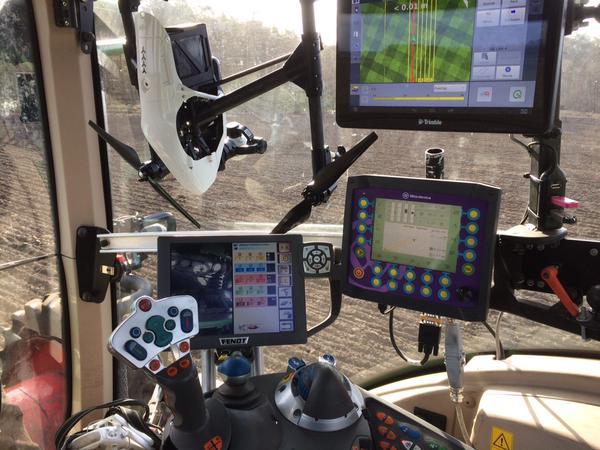
Mistrale, a project to develop a soil moisture monitoring drone funded by the GSA under the Horizon 2020 Framework Programme for Research and Innovation, is changing the way European farmers decide on where, when and how much to irrigate. The UAV-mounted sensor produces a detailed map showing the soil moisture differences in an area.
“The population of the world is growing by two billion people,” says Jeroen Verschoore, one of the project managers. “To feed this increasing population requires higher yields. One way is to increase production is to improve the water supply since irrigated crops have a two times higher yield than non-irrigated crops. Adequate soil moisture mapping is a relevant tool to understand the different water needs in different corners of the field.”
Mistrale uses GNSS Reflectometry to create soil moisture maps for farmers and decision makers on water boards and in nature management. The project started in March 2015, and the first test flight was completed in early August. For this test flight a manned aircraft was filled with extensive equipment. Verschoore says this will be downsized and in the future Mistrale will be able to conduct surveys using UAVs.
Also Read: Precision Agriculture Helps Feed Earth’s Growing Population
Currently, an antenna on top of the plane registers the signals of Galileo satellites (on top of GPS and GLONASS ones), measuring their signal’s strength and position. Another antenna located on the bottom of the plane measures the reflected signal, with the characteristics of the reflections revealing the amount of moisture in the soil. “We use GNSS for multiple purposes,” explains Verschoore. “For example, we use EGNOS and, in the future the Galileo signal, both to navigate and for the remote sensing of soil moisture.”
The second part of the project involves computing a detailed map of the field depicting the areas of different moisture levels via a user-friendly interface. The objective is to extract soil-moisture data and quickly deliver the corresponding map to a farmer or reservoir manager within an hour. Verschoore stresses the importance of this time element: “When you are talking about irrigation you have to be quick,” he says. “When a farmer thinks the soil is dry, he wants to be able to easily measure and find an immediate solution.”
The European GNSS Advantage
MISTRALE uses European GNSS data for both navigating the UAV and for measuring the soil moisture underneath the area it is flying.
The use of Galileo signals, with the larger bandwidth and different carrier frequencies, will significantly improve the precision of mapping. EGNOS will help in improving the vertical accuracy of the positioning solution of the UAV.
Using Galileo satellite signals and UAVs, accurate, cost-efficient soil moisture maps will be produced with a high spatial resolution and flexibility in time: one can fly Mistrale immediately when there is a need to probe the soil humidity conditions. The Mistrale solution is very agile compared to other mapping techniques and can be used where ever information about soil moisture is necessary, including agricultural fields, flooded areas and natural reservations, to name just a few.
Watch This: Mistrale at the European Space Expo in Milan
The Mistrale project will run for three years. The project will move to the UAV stage within the next two and a half years, as Galileo-based solution offer farmers more precise and faster measurements than available with current sensors or Earth Observation data.
“When you look at a field, you have to look at the differences in soil and height, and also at the crop,” Verschoore says. It is not easy to install a soil sensor. If it was placed next to a potato plant, or another plant that uses a lot of water, the soil could seem dry when just a few feet away it’s much moister. “You need to measure the whole field, and by using the Galileo system you can quickly obtain a high resolution moisture map of your field” he says.
A Group Effort
The Mistrale project brings together a number of European partners. STARLAB provides the front end and the algorithms for the GNSS-R instrument, while M3Systems delivers the back end and implements EGNOS for GNSS integrity for the UAS navigation. GET analyses user needs and inputs data for scientific processing. L’Avion Jaune does the test flights and demonstrations, and ENAC is developing the UAS. AeroVision is responsible for dissemination and the advisory board.
Media note: This feature can be republished without charge provided the European GNSS Agency (GSA) is acknowledged as the source at the top or the bottom of the story. You must request permission before you use any of the photographs on the site. If you republish, we would be grateful if you could link back to the GSA website (http://www.gsa.europa.eu).