
The Position on Precision at Munich
Disclaimer
This page has been archived and is provided for historical reference purposes only. The content and links are no longer maintained and may now be outdated.
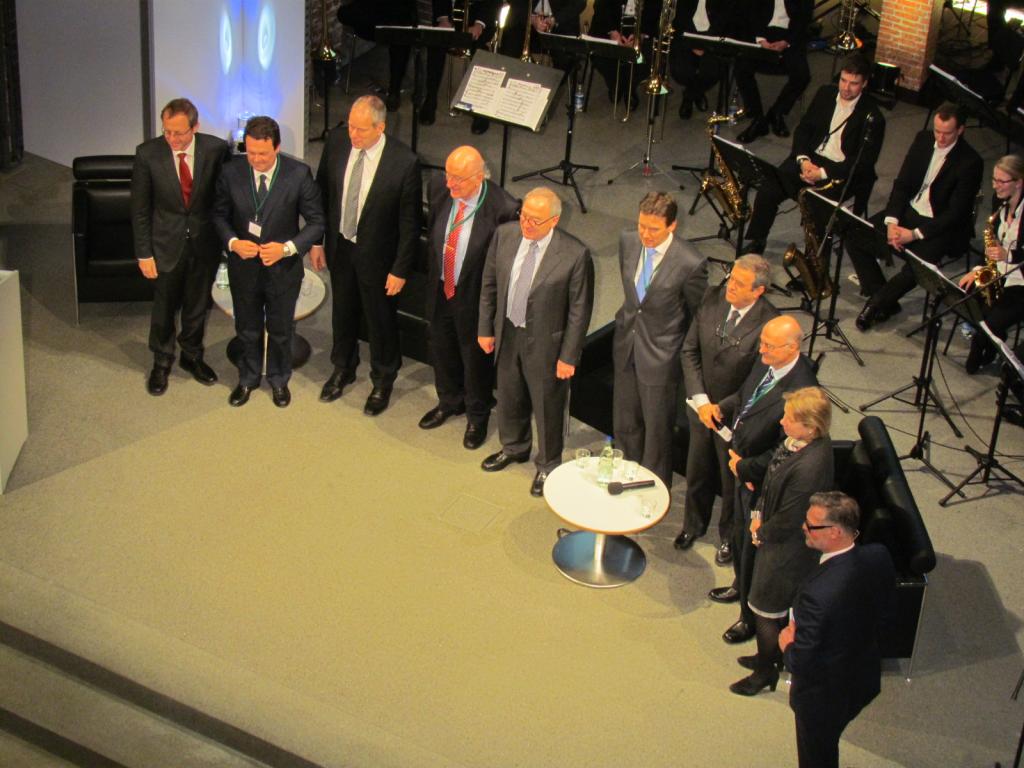
Many GNSS applications call for extremely high accuracy – down to the centimetre level. These include surveying, precision farming and machine control. The GSA discussed current and future issues surrounding Precise Point Positioning at the Munich Satellite Navigation Summit.
During a panel discussion on the topic of Precise Point Positioning (PPP), Gian-Gherardo Calini, Head of Market Development at GSA, presented the GSA’s ideas concerning the provision of high accuracy PPP corrections over the Galileo E6 signal, also known as the Galileo Commercial Service (CS). 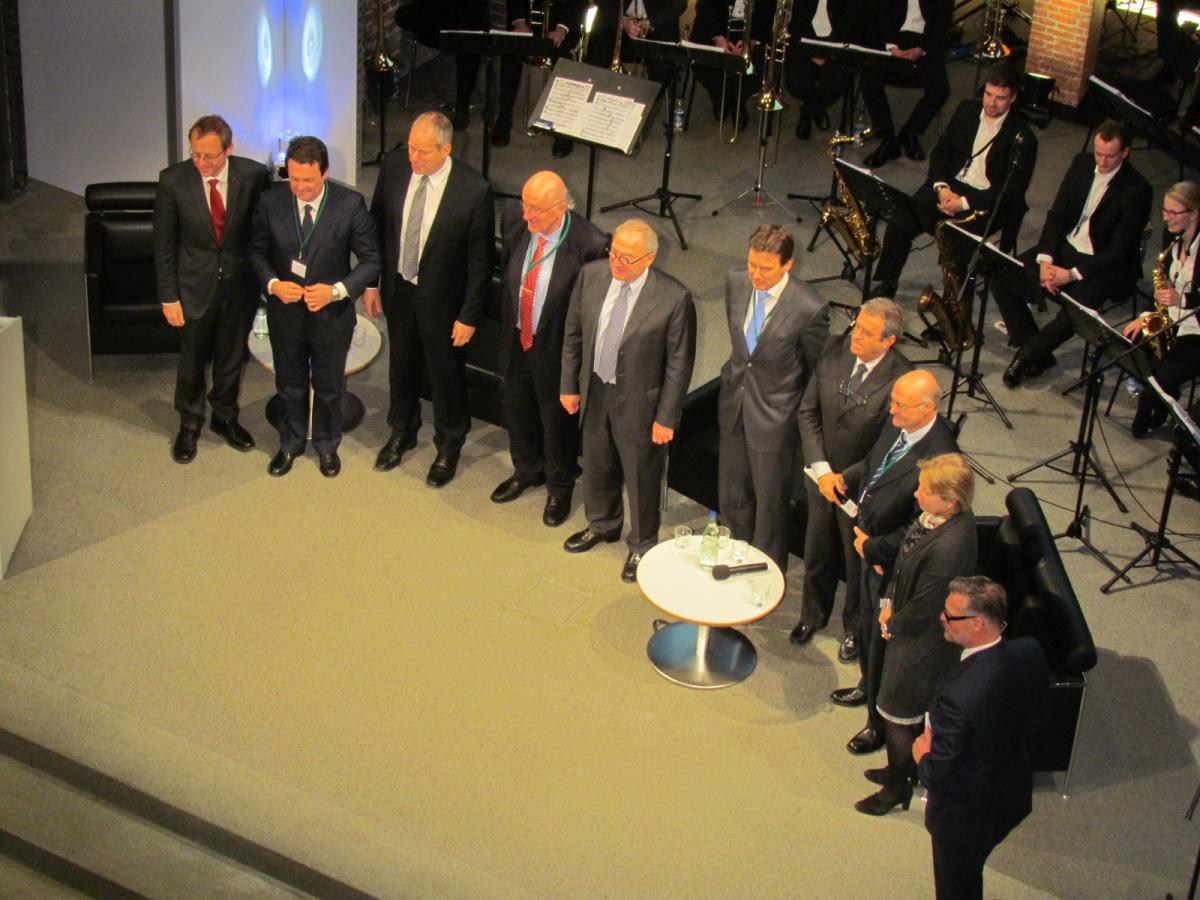
Mr Calini emphasized that although the intent was not to disrupt the current commercial marketplace, the GSA is proposing a public funded service that would be sold to users within a market.
Galileo, whose service is aiming to enable high accuracy end-to-end solutions. According to Calini, early testing of real-time PPP with Galileo has shown good results in comparison to GPS and GLONASS. GSA is working on an overall E-GNSS strategy that looks to integrated content and application development.
Accuracy Everywhere
To illustrate the high-level capabilities of PPP, Peter Large from Trimble discussed how today it was possible to go on the street and access positioning accuracy down to 3-4 centimetres. Noting that “accuracy is addictive”, he anticipates PPP expanding beyond its traditional market to include transport applications.
This point was further emphasised by Novatel’s Michael Ritter. “PPP is the future and it will replace traditional networks and single base stations in many applications,” he said. “More so, PPP will open up additional applications for GNSS.”
Convergence times are an issue and industry is seeking solutions to give 1-2 minute convergence with minimal or no increase in base station service. However, Ritter did warn that the high accuracy that PPP can achieve could be perceived as a threat by some governments running their own ground infrastructure.
According to Peter Toor of Veripos, the key strengths of PPP are its ability to provide globally applicable corrections and its ease of use and reliability. Referring to non-commercial services he stated that providing a high performance service requires money and resources, whereas a free service has to compromise on this.
Hans Visser of Fugro emphasised that future accuracy down to the millimetre scale could be achieved by combining data from multiple constellations, perhaps with only a 20 second convergence time. He also stated that Galileo data was needed to help filter scintillation interference and improve data availability in such blockage areas as ‘urban canyons’.
Like a number of industry experts at the Munich Summit, he asserted that Galileo provided superior data to existing GNSS and, in particular, better quality code and phase measurement signals – two data of considerable importance to high accuracy measurements.
The Role of Galileo
If there is one consensus that came out of Munich it was that improving convergence time was key to the future development – and use – of PPP.
All presenters agreed that Galileo was needed for high accuracy starting in 2018. Achieving this will allow for the development of new applications that can open new markets and fundamentally change the PPP sector.
The GSA ensures that there will indeed be a consultation process, reassuring companies that the GSA will take steps so as not to disrupt the market.
- Peter Large, Trimble
Media note: This feature can be republished without charge provided the European GNSS Agency (GSA) is acknowledged as the source at the top or the bottom of the story. You must request permission before you use any of the photographs on the site. If you republish, we would be grateful if you could link back to the GSA website (http://www.gsa.europa.eu).
More information:
The European GNSS Agency
EGNOS Portal
Munich Satellite Navigation Summit 2014