
Power saving solution wins inaugural GSA prize at Geo IoT World Awards 2016
Disclaimer
This page has been archived and is provided for historical reference purposes only. The content and links are no longer maintained and may now be outdated.
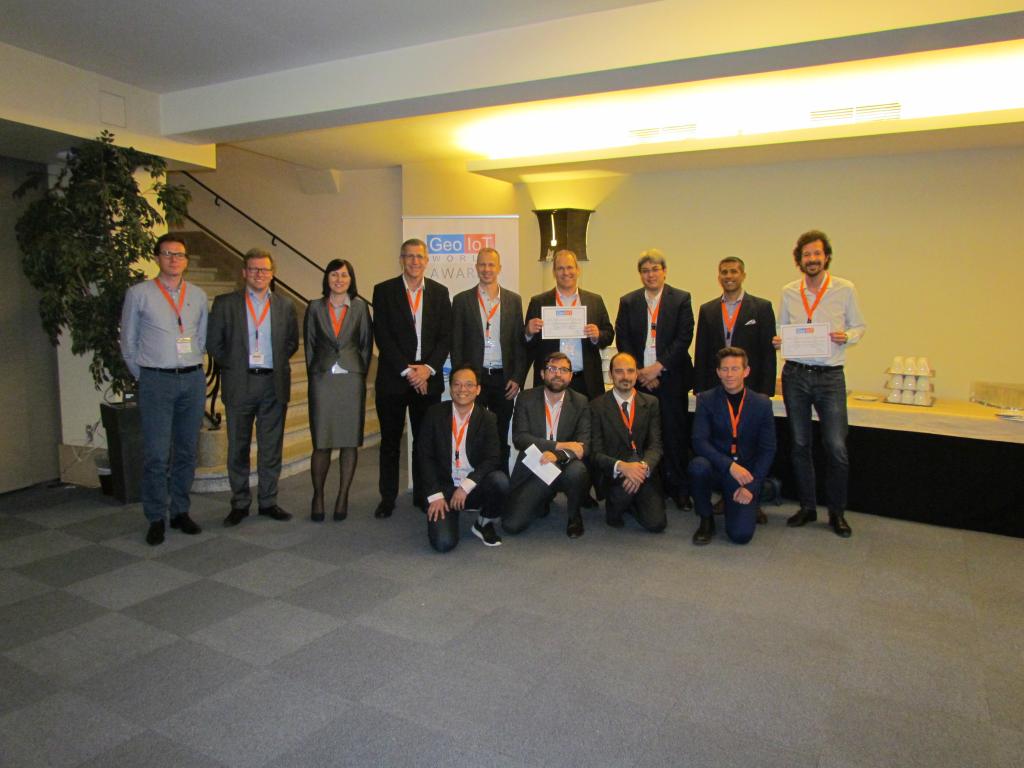
French start-up UBISCALE was named the winner of the first GSA “IoT Solutions empowered by GNSS” award at the 2016 GEO IoT conference.
The Internet of Things (IoT) is everywhere, connecting smartphones, tablets and industrial and home appliances, and making roads, cities, factories and appliances smarter. In every sector of the economy, IoT is enabling objects to exchange data with manufacturers, operators and other devices to create a vast integrated network of connected things and services that is expected to surpass a volume of 50 billion by 2020.
Global Navigation Satellite Systems (GNSS) such as Galileo and EGNOS play a key role in IoT, providing the positioning, velocity and timing information required by an increasing number of context-aware applications.
To raise awareness of the integral role that GNSS plays in IoT, the European GNSS Agency (GSA) sponsored the IoT Solutions empowered by GNSS award within the GEO IoT World conference on 25-26 May in Brussels.
“Galileo brings IoT better accuracy and availability due to its signal strength in such difficult environments as in the city, as well as an authenticated open signal,” says GSA Executive Director Carlo des Dorides. “With this award, the GSA was looking for the most innovative IoT applications that rely on GNSS and leverage the enhanced possibilities offered by Galileo – and we found such an application in UBISCALE, this year’s winning company.”
Power saving solution
At the centre of this winning concept is the UbiGNSS™ technology and service that enables true low‐power GNSS‐based IoT services. The UbiGNSS™ solution’s essential insight is that for tracking applications, the device itself does not need to know its position, although the service side tracking applications does.
“From this assessment, we achieved power‐optimised GNSS pre‐processing for end‐devices and shifted the actual calculation of the position to a cloud‐based server, while sustaining the low data rate of Low‐Power Wide‐Area Networking (LPWAN),” says UBISCALE General Manager Samuel Ryckewaert who, along with CTO Mikaël Guenais, received the award during a special ceremony in Brussels. “In comparison to architecture based on GNSS computing the position at the device, the combination of GNSS and LPWAN used in UbiGNSS™ can cut power consumption by ten times, which enables unprecedented battery‐operated and truly cost‐effective tracking applications.”
UbiGNSS™ technology has been engineered to be compatible with all major GNSS systems, but the company anticipates that Galileo, thanks to its modulations and signal strength, will provide additional benefits, especially in terms of urban and other challenging environments.
The company is also anticipating a swift entry into the market. “With the advent of LPWAN networks, we believe our entry is arriving at the right time on the market,” says Guenais. “LPWAN networks are expected to represent 25% of total IoT connectivity by 2020 and will unleash a large volume of opportunities in lower-end devices.”
As well as working with new tracking devices, the UbiGNSS™ solution can also be applied to existing trackers as a firmware upgrade.
In reaching their verdict, the jury, which included GSA Market Development Officer for IoT and LBS Justyna Redelkiewicz and other industry experts, praised the UBISCALE solution, saying: “Power consumption is one of the main barriers for GNSS adoption in IoT. As this project tackles this problem, we think it will have a huge impact on the market.”
In recognition of their achievement, the company received a GSA ‘prism’ trophy and certificate. In addition, UBISCALE will be funded for a business incubation period tailored around their needs, which could include market analysis, business strategy and business plan development, resource mobilisation strategy and international positioning. Furthermore, the company will have access to networking opportunities with industry and investors, investor relations and investor scouting, a dedicated team of GSA-accredited consultants and coaches, along with an extensive network of industry and institutions – all specialised in the GEO IoT market.
EAGLE award
In addition to the main prize, the GSA also announced a special prize awarded to the EAGLE (Enhanced Authentication with GaLileo dEvice) device, entered by Italian venture SpaceEXE. This concept integrates a high‐precision GNSS receiver with the capability of authenticating position through the GNSS satellite signal recording, the I.D. satellite tracked, and their position in orbit.
The application will enable local authorities to create ‘Fluid Limited Traffic Zones’ to dynamically regulate access to city centres, thus setting a new standard for city mobility. The technological novelty of the product is the civil use of authentication of the Galileo GNSS signal, paired with a massive cloud based system capable of monitoring multiple vehicles in real time. “The idea of this project is very interesting since it provides flexibility for city traffic management while leveraging Galileo Open Service authentication,” says Redelkiewicz.
Media note: This feature can be republished without charge provided the European GNSS Agency (GSA) is acknowledged as the source at the top or the bottom of the story. You must request permission before you use any of the photographs on the site. If you republish, we would be grateful if you could link back to the GSA website (http://www.gsa.europa.eu).