
Register Today for e-KnoT Professional Training Programme
Disclaimer
This page has been archived and is provided for historical reference purposes only. The content and links are no longer maintained and may now be outdated.
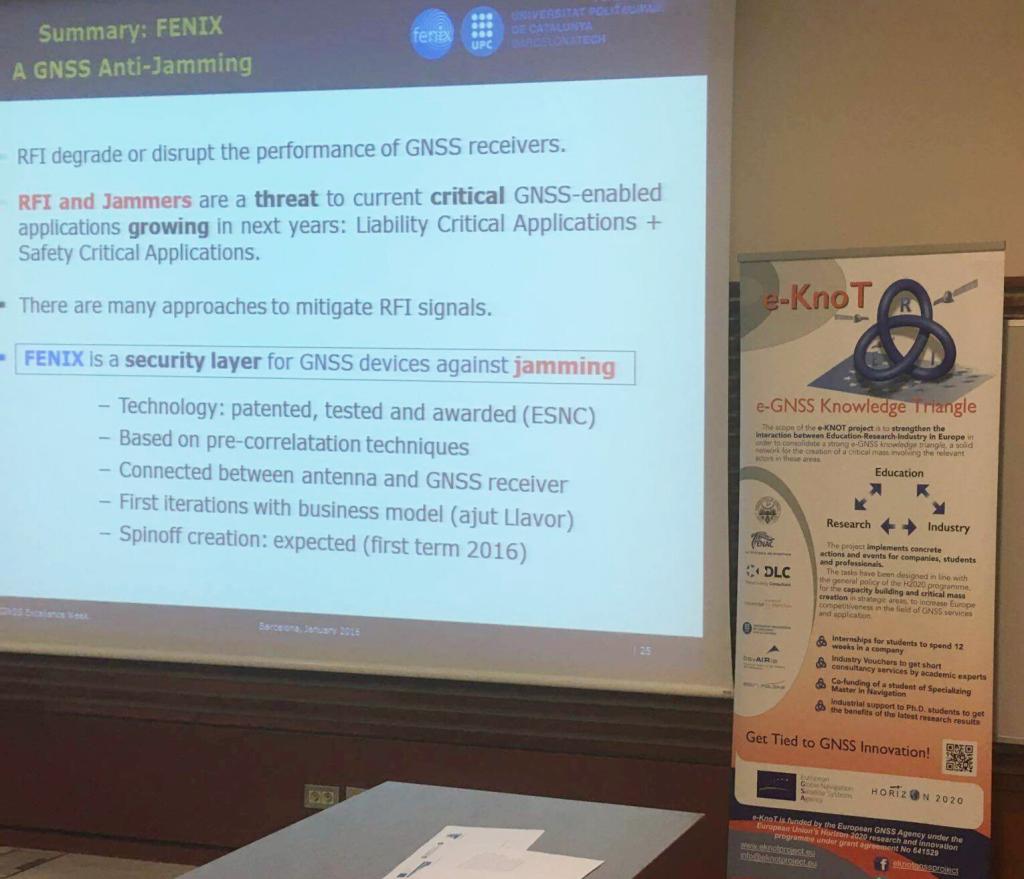
The European GNSS Agency (GSA) announces that registration is now open for the 2016 e-KnoT Professional Training Programme – an opportunity for industry, research centres and institutions to take part in free-of-charge tutorials led by recognised GNSS experts.
Registration is now open for the 2016 e-KnoT Professional Training Programme, an opportunity for industry, research centres and institutions to expand their GNSS knowledge base and develop new skills via specialised courses designed and delivered by leading GNSS experts.
The programme, which is supported by the European Commission and the GSA through Horizon 2020, aims to provide direct benefits to industry by implementing measures to strengthen GNSS knowledge and foster cooperation between academia, research and business to boost innovation.
The e-KnoT professional training programme instructors include GNSS experts from the Ecole Nationale de l’Aviation Civile (France), Politecnico di Torino (Italy), Universitat Politècnica de Catalunya (Spain), and Astri Polska (Poland).
The 2016 training programme schedule is as follows:
- T1: Fundamentals of GNSS, 30 March - 01 April 2016, Universitat Politècnica de Catalunya, Barcelona, Spain
- T2: GNSS Receiver Signal Processing, 23-25 May 2016, Astri Polska, Warsaw, Poland
- T3: GNSS Positioning: Theory and Practice, 07-09 June 2016, GSA Headquarters, Prague, Czech Republic
- T4: Vulnerabilities of GNSS, 18-20 October 2016, Politecnico di Torino, Torino, Italy
- T5: Integrity Monitoring for Safety-Critical Applications, 22-24 November 2016, Ecole Nationale de l’Aviation Civile, Toulouse, France
An In-depth Curriculum
In Fundamentals of GNSS, participants will receive a beginners’ guide to GNSS. Current and future systems, the concepts behind global positioning, how a signal is used to determine location by a receiver – and more – will all be discussed. As the course progresses, discussions will cover the sources of GNSS errors and available augmentation systems for service enhancement, along with a talk on the future of GNSS and the European Galileo system.
In GNSS Receiver Signal Processing, intermediate level students with some knowledge of signal processing will delve deeper into the topic. The course starts by looking at the specific case of GPS L1 C/A and its basic processing in a GPS receiver, before investigating the effect of multipath and interference on such processing. The second part of the course introduces the numerous innovations present in the new GNSS signals and their implications on the structure and performance of GNSS receiver signal processing.
GNSS Positioning: Theory and Practice is an entry level course that examines the study of the concepts and techniques used in GNSS positioning. The theoretical foundations are presented and the processing algorithms are implemented through guided exercises performed right in the laboratory. The practical sessions will consist of programmes specifically about implementing the different processing modules.
In the expert level Vulnerabilities of GNSS course, participants will look at the fundamentals relating to GNSS signal processing and GNSS position and time computation. The course will also provide a description of the origin, effect and means of mitigating various sources of vulnerabilities to a GNSS receiver.
Finally, in Integrity Monitoring for Safety-Critical Applications, intermediate level participants will learn about the Integrity Monitoring techniques used in civil aviation and the latest advances in the field.
Register Today
Registration is free-of-charge, but places are limited and are filling up quickly. The registration deadline is one month before the start of each tutorial, and confirmation of registration will be required three weeks before the tutorials begins.
You can submit your application here.
Media note: This feature can be republished without charge provided the European GNSS Agency (GSA) is acknowledged as the source at the top or the bottom of the story. You must request permission before you use any of the photographs on the site. If you republish, we would be grateful if you could link back to the GSA website (http://www.gsa.europa.eu).