
Scutum 'Think Tank' on GNSS for dangerous goods
Disclaimer
This page has been archived and is provided for historical reference purposes only. The content and links are no longer maintained and may now be outdated.
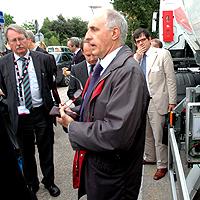
The ‘Scutum’ project held its first project event at the 8th ITS European Congress and Exhibition on Intelligent Transport Systems and Services (ITS in Europe 2011) in Lyon, France. This ‘Think Tank’ discussed the use of GNSS in support of dangerous goods transport (DGT).
Scutum is a, EU-funded research project aimed at promoting the wide adoption of satellite navigation- based technologies and services for the management of hazardous goods transport. The Scutum Think Tank in Lyon was opened by Gian Gherardo Calini, Head of Market Development at the GSA, who said, “The transport of dangerous goods is a key element of ITS, and public institutions should be encouraged to support the positive business cases emerging for EGNOS in dangerous goods transport through the Scutum project.”
Edgar Thielmann, Head of Unit for EU Satellite Navigation Programmes at the European Commission’s Directorate-General for Enterprise, explained current European initiatives and opportunities.
Extending use of EGNOS across Europe
The Scutum project is carrying out trials with Eni, an Italian oil transport company that uses EGNOS to monitor its fleet transporting hydrocarbons in Italy.
The firm provided a demo of their GNSS track and trace system, currently fitted to 450 vehicles. A lorry on display outside the workshop venue was one of the 230 that have been fitted with EGNOS in order to provide a ‘confidence level’ signal that tells the operator the truck is located within a circle of defined diameter.
The Italian and French ministries of transport are participating in the project to validate the benefits of EGNOS for the provision of guaranteed track and trace services to improve safety. Scutum is also focusing on standardisation as a pathway to Europe-wide implementation. The project plans to sign a CEN Workshop Agreement on EGNOS/EDAS-based services for track and trace in goods transport by December 2011. This specification will apply to dangerous goods transported by road, but should be extendable to other types of freight and transport.
The Think Tank also allowed a panel of stakeholders to discuss regulatory needs as well as initiatives demonstrating the benefits of new technologies in the management of dangerous goods in various transport modes.
Safety and security require international coordination
 Gian Gherardo Calini (right) speaking at the Scutum Think Tank. ©Hywel Jones
“A lot of freight is transported across borders, including dangerous goods,” said Massimiliano Zazza of the Italian Ministry of Infrastructure and Transport. “Therefore we need to share control strategies and common rules.” The challenge is huge, he said, with 1.25 trillion tonnes of freight carried by road in Italy in 2002. Of this, 80 million tonnes were dangerous goods.
Helmut Rein from the German Ministry of Transport emphasised the distinction between safety and security: “There are 1200 pages of international safety legislation, whereas security is rather new at the international level, and has only five pages of regulations.” Dangerous goods transport is often intermodal and international, with many organisations involved, so it is right that binding rules are stipulated at international level, he said.
“We cannot achieve 100% of our safety and security aims using traditional methods,” said Rein. New systems should make available all information to emergency services immediately after accidents, including which goods were being carried and the impact of events such as fire, gas leaks, etc.
With support from the French Transport Ministry, the research centre, Centre d’Études Techniques du Sud-Ouest (CETE-SO) is developing a comprehensive database that includes details on vehicle contents, including track and trace, empty/full, packaging codes, as well as real-time road information, such as position and speed, road works and closures. It alerts emergency services and can help send the right team and equipment in case of an accident.
Eric Louette of the French Transport Ministry presented the project. “Currently, systems are proprietary and not interoperable,” he pointed out, “so there is a need for Europe-wide standards and systems.”
Following presentations by transport authorities, it was the turn of large logistics operators to present their thoughts. Alexander Klacska of the Austrian logistics group that bears his name explained how today’s logistics operators have become a crucial part of their customers’ processes, charged with key responsibilities as well as service delivery. New GNSS technologies such as EGNOS, adopted by Klacska at the request of Eni, are playing an important role.
The European approach
“Europe is moving very fast in the area of GNSS technologies,” said Edgar Thielmann of the European Commission, in his concluding remarks. “With the EU ITS Directive currently being implemented and the launch of two Galileo satellites now expected in October 2011, Europe is clearly interested in being an active player in the world scene.
“Traditionally, safety is an area where the state has to pay an important role,” he said, “and we have been very pleased to see industry, users and universities working together, especially in relation to regulation.
“What should be our next steps?” he asked, “Standardisation? Well, the process can be slow but, as the example of the EU ITS Directive shows, there are ways of speeding up the process.”
And, with more and more Member States planning to implement tolling schemes related to congestion, timing or taxes, where tariffs for individual vehicles depend on various parameters, special attention must be paid to reliability.
“With GNSS, we have a very easy-to-use, very secure, very precise tool that did not exist before,” finished Thielmann. “We see from the rise in GPS and smartphone devices that the market is interested.” Indeed, market studies indicate that localisation services will continue to grow at two-digit percentages per year. “Regulation to require localisation services for health and safety could be another driver to provide a market push.”