
Space solutions for feeding a growing population: 1-day workshop
Disclaimer
This page has been archived and is provided for historical reference purposes only. The content and links are no longer maintained and may now be outdated.
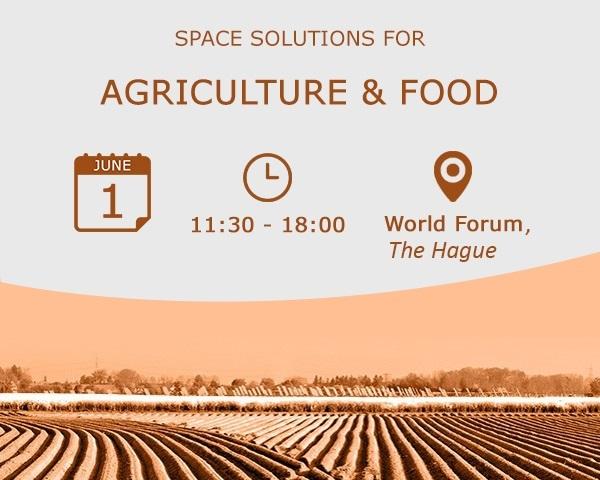
How can agriculture-focused organisations benefit from European satellite navigation and Earth observation information? You can get the answer to this and more on 1 June at a 1-day workshop on space solutions for feeding a growing population during the European Space Solutions conference.
By 2050, the world’s population is predicted to have increased by 2 billion, reaching a total population of 9 billion people. To cope with this reality, the agriculture industry must maximise the use of available resources. Precision agriculture, which uses satellite navigation to help increase crop yields and improve efficiency, will play an important role in this effort. In fact, the role of geospatial data, Earth observation and positioning as applied to agriculture has been brought to the forefront by the 2015 United Nations Millennium Development Goals Report.
According to the report, Global Navigation Satellite Systems (GNSS) such as Galileo, the European Geostationary Navigation Overlay Service (EGNOS), along with Earth observation programmes like Copernicus, are not only helpful in boosting agribusiness productivity, but are also key to achieving the kind of food production necessary to sustain the planet’s growing population. Furthermore, these programmes support the implementation of various EU agricultural policies – particularly with regards to market transparency, control and evaluation of direct payments, and the establishment of an improved common agricultural policy (CAP).
An array of applications
As European and worldwide farmers’ needs have become increasingly sophisticated, they were early adopters of precision agriculture as a solution for higher productivity and farm profitability. While the technology has a variety of uses, the main application for precision agriculture is tractor guidance, where positioning applications can be used to guide a tractor around a field and minimise the effort exerted by a farmer. More so, Earth observation satellites provide imagery of agricultural fields, along with radar, topographical and altimetry information. The results are an increase in efficiency and a decrease in labour costs. EGNOS especially can be used to help farmers enhance crop management and improve position-based tasks like spraying insecticides and pesticides and harvesting crops. In turn, this increases yields and helps provide the world with a much-needed food supply.
Read more: EGNOS for agriculture
The crop insurance industry can also benefit from positioning and earth observation tools, as the technology creates better models to predict weather patterns and determine crop yields. With this information, crop insurance companies can set predictable rates and mange profits.
As precision agriculture technology becomes more widely available, farmers are demanding advanced applications of satellite technology and are looking for entire farm management solutions. In other words, farmers want technology that allows them to make better decisions and secure more predictable outcomes. To meet this demand, an array of European GNSS Agency (GSA)-supported applications and services are already being developed, enabling business opportunities for companies. For example, the H2020 project GeoPal provides an advanced logistics system for the harvesting and distribution functions of bio-related supply chains. The CLAAS Group has developed GeoPal into a field-route optimisation system that optimises working passes for every field and accurately forecasts the required processing time – resulting in an average cost reduction of 6%. Another example comes from the Mistrale project, which seeks to provide soil moisture maps using GNSS reflectometry, helping farmers maximise water efficiency.
Another company benefiting from GNSS technology is AGCO, which currently uses EGNOS – and soon Galileo – for precision mapping for harvest yield. Farmnet 365 also uses EGNOS in its food traceability technology, which currently saves 5 % of working time for farmers and EUR 10-15 per hectare.
Ample opportunities
This cutting-edge technology has grabbed the attention of businesses, industry, small and medium-sized enterprises (SMEs) and entrepreneurs around Europe and beyond, looking to secure a share of this growing market. According to the latest edition of the GSA GNSS market report, from 2013 to 2023, annual shipments of GNSS devices are expected to increase fivefold – up to almost 1.2 million units worldwide. Overall, GNSS penetration is foreseen to experience a steady increase over the next decade, reaching 50 % by 2023. Specifically, variable rate technologies will progressively gain momentum, with revenues increasing from EUR 135 million in 2013 to EUR 723 million in 2023. Likewise, revenues from asset management will grow from EUR 11 million in 2013 to EUR 102 million by 2023. Of the total revenue associated with the agriculture sector, automatic steering will generate the largest share and remain the most expansive application in terms of average price per device.
In summary, the GNSS market as it applies to agriculture represents a massive opportunity for European businesses, SMEs and entrepreneurs. To help European industry better understand – and access – this lucrative market, the European Commission and the GSA, under the auspices of the Dutch Council Presidency, are organising a special session on GNSS and agriculture as part of the European Space Solutions Conference.
Register today!
The Agriculture and Food Focus Session will address a wide range of applications for agriculture companies, including crop and soil monitoring, production forecasting, and land and irrigation management. The session will cover both state-of-the-art solutions and the latest research and development (R&D) innovations, with the objective of further promoting dialogue between the agribusiness and space sectors, with a focus on highlighting the many opportunities available for European businesses.
Users from both the public and private domains will be present, including speakers from the European Commission, European agriculture associations, the GSA, European and non-European agri-businesses and equipment manufacturers, including the CLAAS Group, Ariespace s.r.l. and Copa Cogeca, among others. The workshop will discuss the use of Galileo, EGNOS and Copernicus in such arenas as crop classification, CAP, logistics and land monitoring – among others. A round table discussion is an integrative part of the day, addressing the needs of agriculture businesses and how they can benefit from the EU space solutions.
The all-day workshop will take place on 1 June 2016 as part of the European Space Solutions Conference in The Hague, The Netherlands. To ensure your business doesn’t miss out on this unique opportunity to get first-hand insights into how space offers real solutions to agriculture and food production, secure your place by registering today.
Media note: This feature can be republished without charge provided the European GNSS Agency (GSA) is acknowledged as the source at the top or the bottom of the story. You must request permission before you use any of the photographs on the site. If you republish, we would be grateful if you could link back to the GSA website (http://www.gsa.europa.eu).