
EU Space Market Report 2026: planning Europe’s blue economy
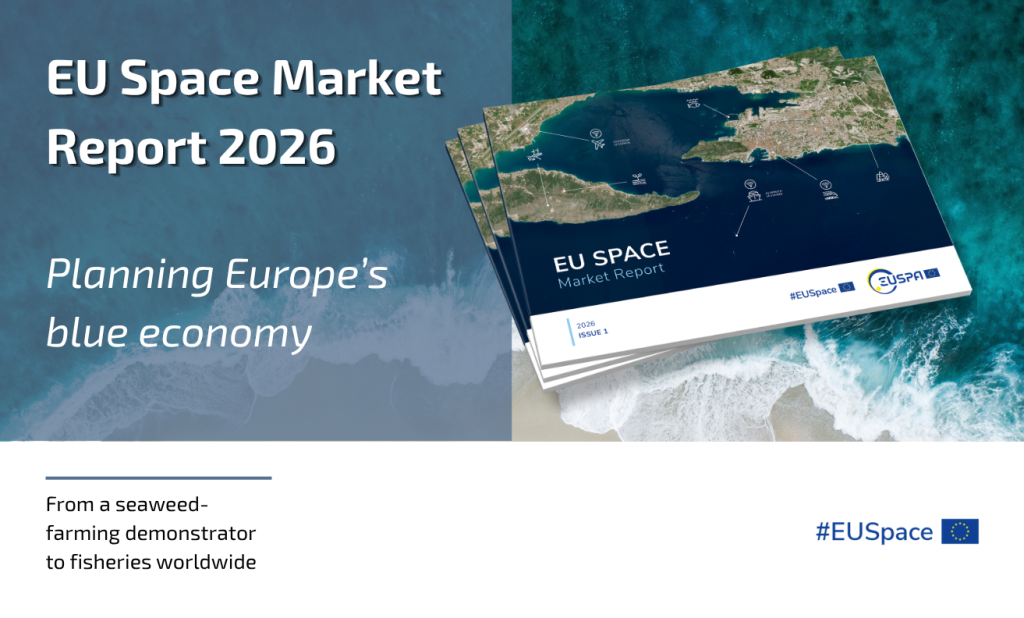
Aquaculture is becoming a vital part of the EU economy, supporting food security and a range of industrial applications. At the same time, climate change and the growing need to identify suitable locations are making reliable, readily available data essential for planning and growth. The EU Space Market Report analyses how EU Space data and EUSPA-supported applications are responding to this need.
Farming the sea is growing more unpredictable. The EU Space Market Report 2026 notes that global warming is putting increasing pressure on the aquaculture industry as the risk of potentially devastating algal blooms grows. Meanwhile, aquaculture sites are increasingly being pushed further offshore in search of space, exposing operators to currents, storms and conditions that are difficult to monitor.
In 2022, aquaculture surpassed capture fisheries as the main source of aquatic animals for the first time. For this fast-growing industry, knowing where and when to operate has become a critical challenge.
Seaweed producers feel this pressure acutely. Europe’s seaweed market is expanding quickly, driven by demand from the food, cosmetics and biofuel industries. More broadly, the demand for aquatic protein could double by 2050, underlining aquaculture’s increasing role in food security. However, profitable cultivation depends on selecting viable sites based on detailed, up-to-date knowledge of water quality and ocean conditions.
To address this, EUSPA’s Copernicus Demonstrator for fisheries and aquaculture combines data from the Copernicus Marine Service and the European Marine Observation and Data Network to monitor water quality and ocean-state parameters and identify seasonal and spatial patterns relevant to seaweed farming.
Demand for this kind of insight is rising steadily. Revenue from Earth observation (EO) data and services across fisheries and aquaculture applications is projected to reach over €200 million by 2034. Seaweed farmers can use the demonstrator’s near-real-time and historical data to support decisions on where to establish new sites and how to plan for key stages such as seeding and harvesting, helping them optimise production while reducing the fuel costs and pollution associated with unnecessary trips.
Copernicus data is not the only space asset supporting the sector. Galileo-enabled positioning also helps vessels cut fuel use through more efficient routing. Copernicus adds a different layer, giving producers and fleets visibility into conditions before they are encountered at sea.
Explore the Ocean State report
Copernicus data powers wider innovation
Similar approaches are emerging in the sector through EU-funded research. The OLAMUR project uses Copernicus Marine Service data on sea-surface temperature, chlorophyll and currents to support the growth of seaweed and blue mussels within wind farms and fish farms in the North and Baltic Seas.
Another Horizon Europe-funded project using EU Space data in the sector is Fish-X, which aims to improve transparency and traceability in fisheries. It has developed a platform that integrates satellite-based vessel tracking, Global Navigation Satellite System (GNSS) positioning and EO data from the Copernicus Marine Service to map fishing activity, monitor marine conditions and support sustainable resource management.
Copernicus is also reaching beyond Europe. The KijaniSpace project combines Copernicus data with Internet of Things sensors to monitor water quality and fish-farm conditions around Lake Victoria, with the aim of helping local farmers and authorities in East Africa manage cage and pond farms more sustainably.
The report also notes that modern aquaculture increasingly uses autonomous feeding barges, drones and robotic maintenance systems, supported by GNSS for precise positioning and EO for monitoring conditions. As Europe’s blue economy grows, reliable data on conditions at sea will assume greater importance. Through initiatives such as the Copernicus Demonstrators, EUSPA is showing how EU Space can support more efficient, productive and sustainable operations.
Media note: This feature can be republished without charge provided the European Union Agency for the Space Programme (EUSPA) is acknowledged as the source at the top or the bottom of the story. You must request permission before you use any of the photographs on the site. If you republish, we would be grateful if you could link back to the EUSPA website.