Galileo OSNMA Day 2026
“These threats are no longer theoretical”
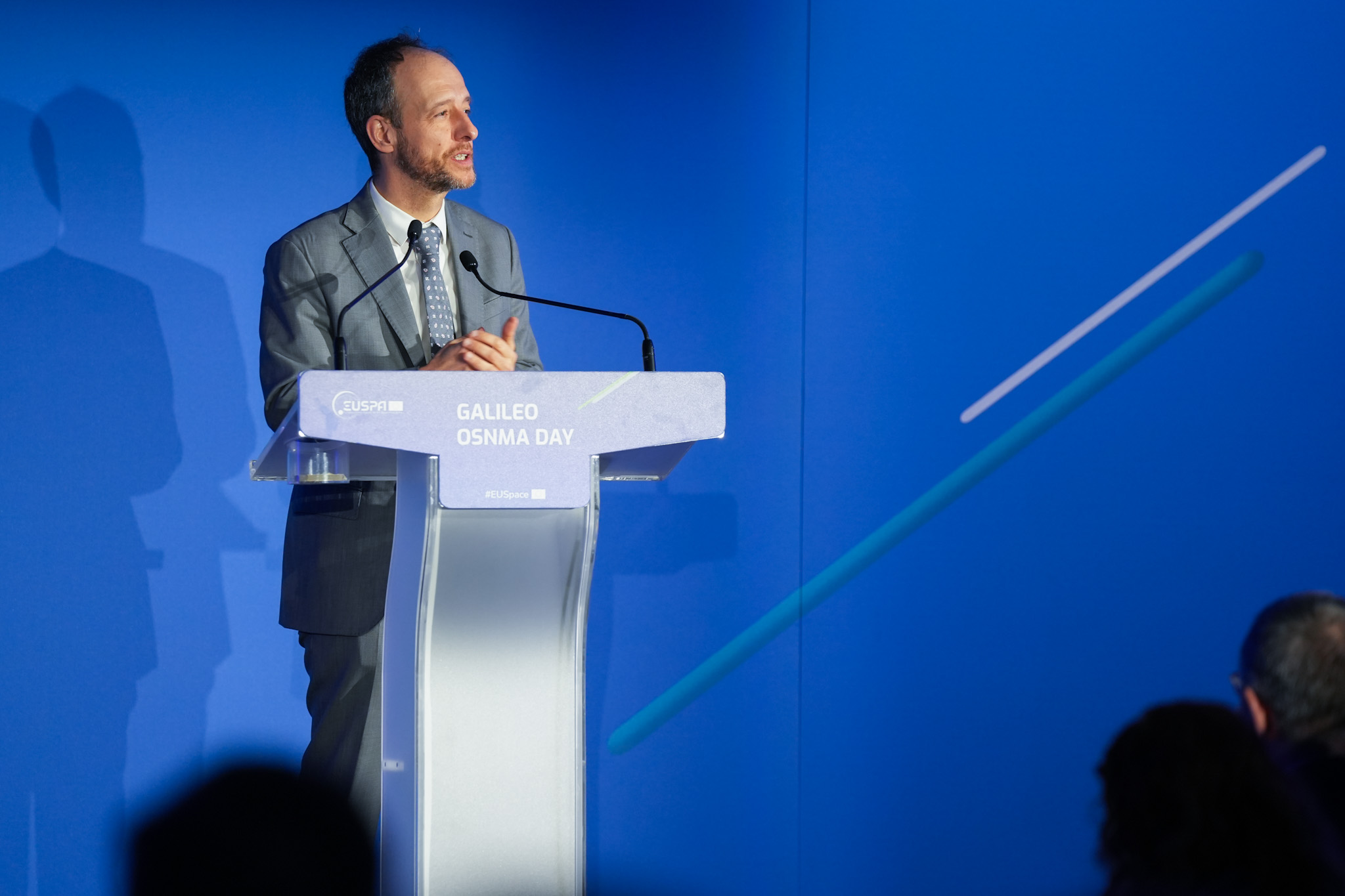
Opening the OSNMA Day on 25 February 2026, Rodrigo da Costa, Executive Director of the European Union Agency for the Space Programme (EUSPA), highlighted the growing impact of GNSS spoofing attacks across sectors.
“Navigation message authentication is already changing how positioning data is used across different sectors. Galileo OSNMA mitigates spoofing threats by allowing users to verify that the navigation data they receive is genuinely from Galileo - and has not been tampered with. In transport, through the next generation of tachographs, Galileo data is not only convenient – it is evidence for traffic authorities in EU Member”, he stressed. Spoofing incidents are increasingly affecting maritime navigation, civil aviation, critical infrastructure and timing services. In this evolving threat landscape, ensuring the authenticity of navigation signals has become essential.
From Initial Service to Market Deployment
Hosted with the support of the Spanish Space Agency and the Instituto Nacional de Técnica Aeroespacial (INTA) in the location of the GNSS Service Centre, the Galileo OSNMA Day gathered the European Union Galileo authentication community, including receiver manufacturers, application developers, institutional stakeholders and international experts.
The event focused on the practical deployment of OSNMA following the declaration of its Initial Service on 24 July 2025. After the Public Observation Phase launched in 2021, this milestone marked the transition from testing to full operational service delivery.
A central objective of the Info Day was to support receiver manufacturers in integrating OSNMA into their products. Since authentication becomes effective only when implemented at receiver level, industry engagement is key to achieving large-scale adoption.
Technical sessions covered protocol implementation, mandatory verification steps, public key management and optimisation strategies. Participants were also introduced to the Galileo OSNMA Receiver Guidelines, providing detailed requirements and verification procedures for implementing authentication functionality in user equipment.
Providing strategic context, Ignacio Fernández from the European Commission, Directorate-General for Defence Industry and Space (DG DEFIS) recalled the structural constraints at the origin of the programme, also emphasizing the strategic dimension of the decision.
“In the early 2010s, the GNSS community became increasingly aware of spoofing. The natural question arose: can we provide authentication using the existing Galileo infrastructure? We couldn’t modify the satellites. At the same time, we had a very weak signal and very few bits available. The protocol had to authenticate as much information as possible with as few bits as possible. Every bit counted.”
From Concept to Concrete Demonstration
The OSNMA Day not only reviewed technical and regulatory developments but also showcased tangible market progress. A growing number of Galileo OSNMA-enabled receivers and implementations are already available, reflecting strong industry engagement.
This momentum was further illustrated in the afternoon session, where eight leading receiver manufacturers (STMicroelectronics, Furuno, ANavS, TeleOrbit/Fraunhofer IIS, Aumovio, Qascom, u-Blox, Qualinx) presented live demonstrations of their solutions. Participants were able to see firsthand how authentication is being embedded into real products and how manufacturers are getting the best out of the opportunities brought by Galileo OSNMA, from enhanced robustness to new service differentiation possibilities.
These demonstrations highlighted a key message of the day: OSNMA is no longer a concept or a pilot phase, It has become an operational capability integrated into commercial receivers.
Ensuring Quality and Future Evolution
Now that the service is operational, EUSPA ensures delivery at the quality level required by users, managing OSNMA-related infrastructure and overseeing service performance.
Beyond operations, EUSPA actively supports adoption across market segments. Through mechanisms such as the User Consultation Platform, the Agency works closely with manufacturers and users to guide future service evolution based on operational needs.
“OSNMA will evolve to authenticate additional Galileo navigation datasets, including those relevant for civil aviation community. In the short term it will be complemented by the Galileo Signal Authentication Service (SAS) to deliver a fully authenticated positioning solution”, declared Javier Simon, EUSPA OSNMA Service Manager.
The OSNMA Day confirmed a shared commitment across institutions and industry: strengthening trust in satellite navigation and reinforcing Europe’s leadership in authenticated GNSS services.
About Galileo
Galileo, the EU´s Global Navigation Satellite System (GNSS), provides improved navigation, positioning and timing information. More than 4 billion users are already benefitting from Galileo.
The Galileo Programme is owned by the EU. The European Commission, as the Programme Manager, oversees the implementation of all activities. EUSPA is responsible for the operational management of the services, ensuring that they are delivered with the defined performance and without interruption. Galileo's system design and system evolution are entrusted by EUSPA to ESA .
Media note: This feature can be republished without charge provided the European Union Agency for the Space Programme (EUSPA) is acknowledged as the source at the top or the bottom of the story. You must request permission before you use any of the photographs on the site. If you republish, we would be grateful if you could link back to the EUSPA website.