
Successful Launch of Galileo L14 Strengthens European Union’s Satellite Navigation Capabilities
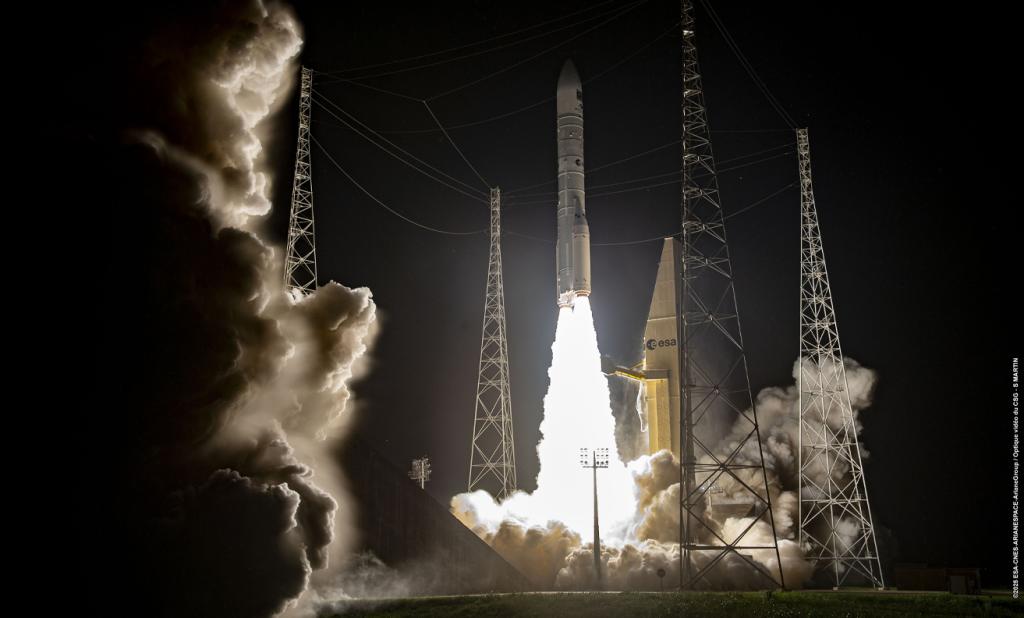
The successful launch of Galileo Launch 14 (L14) marks another major milestone for the European Union’s flagship satellite navigation programme, reinforcing its mission to deliver safe, secure and world-leading positioning, navigation and timing services worldwide.
“If Galileo’s excellence is measured by its continuous, reliable services to billions of users, Galileo Launch 14 remains proof of our commitment to strengthen the constellation, enhance service robustness, and ensure the system’s long-term performance and security,” said Rodrigo da Costa, Executive Director of the EU Agency for the Space Programme (EUSPA).
At EUSPA, responsibilities for Galileo are both operational and strategic. Operational activities begin immediately after launch. Following separation from the launch vehicle, EUSPA takes responsibility for satellite operations during the Launch and Early Orbit Phase (LEOP), one of the most critical and delicate phases of any space mission.
Nearly four hours after liftoff, EUSPA team, supported by SpaceOpal and its industrial partners, ESA and satellite manufacturer experts, took command of the satellites from the Galileo Control Centre in Oberpfaffenhofen, Germany. Initial checks confirmed that communication with the satellites has been successfully established, that they have been released into the correct orbit and that their solar panels have deployed as expected. Reaching this “holding point”, around four hours and forty-five minutes after launch, marks the first key operational milestone.
LEOP then will continue with work around the clock in 24/7 shifts over the following days and weeks, testing all subsystems and executing precise manoeuvres to guide the satellites towards their final operational orbit at 23,220 kilometres. LEOP, together with in-orbit payload testing, lasts around three months and requires absolute precision, teamwork and technical excellence. Only once this phase is completed can the mission be fully confirmed as successful.
Once tested, commissioned and accredited, the satellites will be integrated into the operational Galileo constellation, enhancing service availability, continuity and overall robustness. They will then be monitored 24/7 by the Galileo Security Monitoring Centre, ensuring operational security and protecting the system from threats, an essential part of EUSPA’s mandate.
Beyond operations, EUSPA’s strategic role ensures that Galileo continues to evolve with user and market needs. Satellite navigation already supports applications across mobility, drones, precision agriculture, urban development, emergency response, climate monitoring and many digital services. With the global GNSS downstream market expected to reach around €580 billion by 2033 according to the EUSPA EO and GNSS Market report , Galileo L14 represents not only an operational success, but a long-term investment in European Union innovation, industrial competitiveness and technological independence.
About Galileo
Galileo, the EU´s Global Navigation Satellite System (GNSS), provides improved navigation, positioning and timing information. More than 4 billion users are already benefitting from Galileo.
The Galileo Programme is owned by the EU. The European Commission, as the Programme Manager, oversees the implementation of all activities. EUSPA is responsible for the operational management of the services, ensuring that they are delivered with the defined performance and without interruption. Galileo's system design and system evolution are entrusted by EUSPA to ESA .
Media note: This feature can be republished without charge provided the European Union Agency for the Space Programme (EUSPA) is acknowledged as the source at the top or the bottom of the story. You must request permission before you use any of the photographs on the site. If you republish, we would be grateful if you could link back to the EUSPA website.