
European space-backed hybrid aircraft rewrites the rules of regional flight

Passengers on short-haul flights often face long delays at congested hub airports, with connections adding hours to regional journeys. While the aerospace industry has pinned its hopes on electric vertical take-off and landing (eVTOL) aircraft to solve this, the reality remains tightly bound by the limits of physics: heavy batteries restrict these futuristic vehicles to short, urban hops. Prague-based aerospace company Zuri is integrating EU space services to ensure safe, reliable point-to-point air mobility.
Most electric vertical take-off and landing (eVTOL) aircraft are built strictly for short journeys because their operational range, payload capacity and overall flexibility remain severely restricted. Current battery technology prevents them from becoming a viable alternative for regional cargo and passenger transit.
Established nearly ten years ago, with its eyes fixed firmly on the future, the aerospace company Zuri is pioneering solutions for tomorrow’s challenge: truly decentralised, sustainable aviation. Its goal is to redefine mid-range air travel by offering on-demand, door-to-door flights that bypass the airport. It envisions people flying at their own convenience, free from the constraints of airline timetables.
Vision for airport-free regional air mobility
Over the last decade, a team of around 30 has built and flown more than 15 aircraft to turn this next-generation concept into reality.
This work is leading toward a six-seater tiltrotor aircraft that bridges the gap between sci-fi and modern engineering. The aircraft takes off and lands vertically like a helicopter, then transitions its rotors to fly like an aeroplane. Because the wings generate lift, it is much more energy-efficient than standard helicopters.
By using an advanced hybrid-electric powertrain, Zuri’s design delivers up to 7 times the operational range of pure battery eVTOLs. This enables long-distance regional travel without relying on specialised charging infrastructure. It can also be used in emergency missions and for defence and security operations that require fast deployment.
Pushing boundaries in hybrid-electric aviation
Inside a new research and development facility in Prague, the future of regional flight is physically taking shape. Zuri is currently building Technology Demonstrator (TD) 2.0, a large-scale unmanned aircraft with a 10-metre wingspan, designed to validate the systems behind the future aircraft. More than just a scale model, TD 2.0 marks significant breakthroughs in powertrains, tiltrotors and aerodynamic design that define the company’s hybrid philosophy.
At the heart of the aircraft is a hybrid propulsion system that combines electric and internal combustion technologies to achieve unmatched range, increased operational versatility and a smaller environmental footprint. By leveraging advanced tiltrotors, TD 2.0 can navigate the complex physics of every flight stage – from vertical take-off and landing to high-speed forward cruise. A redesigned tail assembly and optimised propulsion layout lower drag and enhance stability during forward flight.
TD 2.0 will fly as part of the EUSPA-funded Horizon Europe project VITOLMINS, which is coordinated by Spain-based engineering company Pildo Labs. The project consortium is tackling one of the most critical hurdles facing next-generation aviation: ensuring that vertical-capable aircraft can take off and land safely in zero-visibility or severe weather conditions. The solution relies on Europe’s own space programmes: Galileo and EGNOS for navigation, and Copernicus for real-time terrain and obstacle mapping.
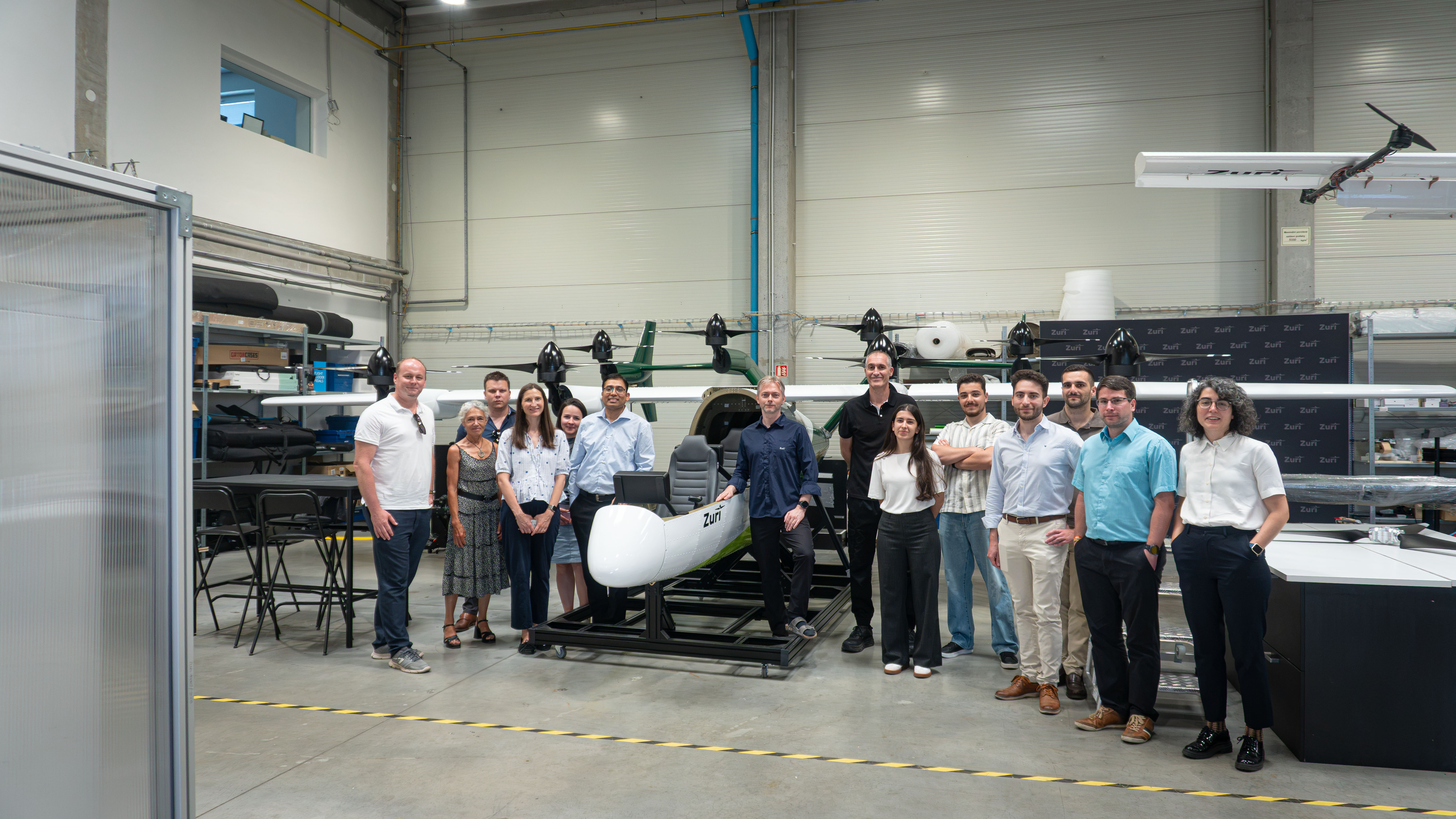
The aviation industry got its first glimpse of this partnership in April 2026 when Zuri unveiled TD 2.0 at AERO Friedrichshafen, Europe’s largest trade show dedicated to general aviation. This showcase was the aircraft’s first public appearance.
While project partner Honeywell focusses on developing the navigation system, including Galileo (DMFC) and assessing also the potential use of Copernicus data for TAWS, Zuri is preparing the aircraft to validate the solution in flight. With construction nearing completion, TD 2.0 is scheduled to make its inaugural flight at the end of 2026, paving the way for flight tests throughout 2027 and 2028.
EU space services for tomorrow’s aircraft
Zuri’s cooperation with EUSPA is thriving under its VITOLMINS project, which the Agency oversees. This support enables the direct delivery of EU space services to next-generation aircraft. By using Union’s space data, the project is establishing a robust framework where futuristic aircraft can seamlessly coexist with traditional airspace.
“For Zuri, VITOLMINS is how Europe’s own space programme reaches a new class of aircraft,” says Robert Demmer, Chief Marketing Officer. “Galileo, EGNOS and Copernicus give our aircraft the navigation that safe vertical flight depends on, and it is European throughout: the aircraft, satellites, data and standards.”
Zuri has been committed to regional and hybrid aircraft from the very beginning. Now VITOLMINS is allowing the company to demonstrate it at the European level, serving as a concrete example of EU space services enabling a new kind of mobility.
Learn more about Zuri’s aircraft technology Visit the website
Media note: This feature can be republished without charge provided the European Union Agency for the Space Programme (EUSPA) is acknowledged as the source at the top or the bottom of the story. You must request permission before you use any of the photographs on the site. If you republish, we would be grateful if you could link back to the EUSPA website.