

EU Space Market Report
-
What is the EU Space Market Report?

-
What does it include?

-
Market segments

-
What is driving market growth?

-
Key highlights

What is the EU Space Market Report?
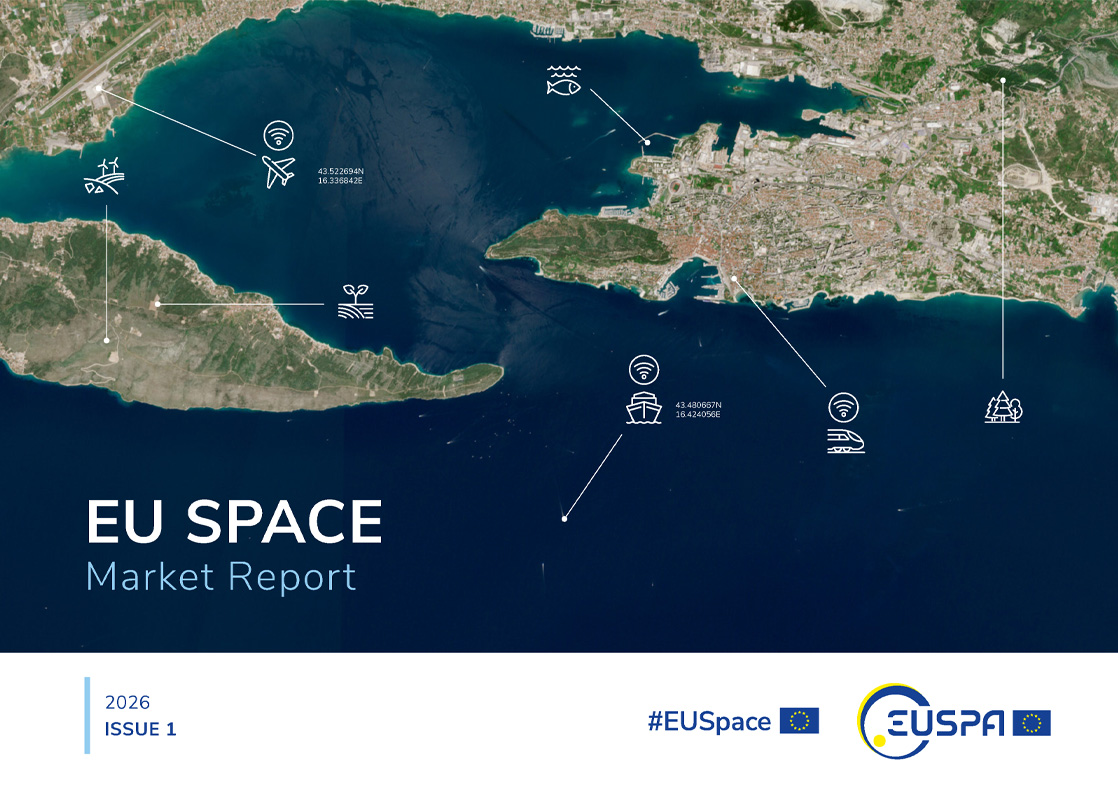
EUSPA has published the first issue of the EU Space Market Report. Building on the coverage of EO and GNSS, the report now broadens its scope to provide a comprehensive overview of markets such as secure SATCOM and SSA.
By expanding its scope, EUSPA further cements this report as the go-to source for insightful information and expertise on the global downstream space sector. It is a must-read for policymakers, entrepreneurs and major corporations seeking to understand the trends shaping the future of the space economy.
What does it include?
The global space market is evolving towards service-driven ecosystems, where value creation comes from downstream applications, analytics and integrated digital services. Published every two years, the Report analyses these developments and provides insights into the evolving downstream space economy.
The report features:

an introduction to the global downstream space application market

EO, GNSS, Secure SATCOM and SSA trends

market size and revenue forecasts across different segments

regional market growth trends

sector-focused analysis covering use cases, recent developments, future market evolution and European systems and projects

key market drivers, including macroeconomic forces, geopolitics, EU space policy and the low Earth orbit revolution
Market segments
The Market Report examines what is happening in 16 market segments.
 Agriculture
Agriculture
Together, EO and GNSS link what is happening on the ground with exactly where it is happening, providing stakeholders with precise, scalable insight into agriculture and enabling more effective, sustainability-driven decision-making.
EO agriculture revenues are forecast to grow between 2024 and 2034.
 Aviation and drones
Aviation and drones
GNSS resilience and U-space development are key pillars for enhancing safety, performance and innovation in aviation and drones.
GNSS signal-loss events due to spoofing or jamming increased between 2021 and 2024.
 Climate, environment and biodiversity
Climate, environment and biodiversity
EO has evolved from a scientific and public-policy tool into a core enabler of climate resilience, environmental regulation and biodiversity protection.
EO revenues are forecast to grow steadily under sustained regulatory expansion and public investment.
 Consumer solutions, tourism and health
Consumer solutions, tourism and health
EO and GNSS are integral components of digital consumer ecosystems, supporting a growing range of location-aware, context-sensitive applications across navigation, health, lifestyle and tourism.
Nearly 2,400 smartphone models were Galileo-enabled by December 2025.
 Emergency management and humanitarian aid
Emergency management and humanitarian aid
Together, and increasingly in combination with AI and secure satellite communications, EO, GNSS and Secure SATCOM are pushing EMAid from reactive response to intelligence-led operations.
Annual shipments of GNSS emergency devices almost tripled between 2013 and 2023.
 Energy and raw materials
Energy and raw materials
GNSS adoption in mining will more than double by 2034, boosting autonomous operations and safer, data-driven extraction.
GNSS shipments for mining applications are forecast to more than double by 2034.
 EU border and internal security
EU border and internal security
Integration of EO and GNSS data with the use of Secure SATCOM increases situational awareness across different operating scenarios.
The installed base of GNSS devices is projected to increase by nearly 3 million over the next decade.
 Fisheries and aquaculture
Fisheries and aquaculture
EO and Galileo support the growth and sustainability of the blue economy.
AI in fisheries and aquaculture is forecast to grow rapidly between 2025 and 2029.
 Forestry
Forestry
EO and GNSS technologies are becoming essential tools, enabling forestry managers to carry out operations more efficiently and allowing governmental bodies to monitor environmental impacts linked to forestry activities.
European firms command over 40% of the EO analysis and decision-support market in forestry.
 Infrastructure
Infrastructure
GNSS and EO continue to be invaluable assets in the toolbox of construction companies, infrastructure managers, public authorities and utility operators.
The Copernicus European Ground Motion Service provides millimetre-accuracy ground-deformation maps at European scale.
 Insurance and finance
Insurance and finance
EO plays an increasingly critical role in supporting insurance companies and financial institutions, while GNSS has become essential for operational integrity in financial markets.
The global agricultural insurance market was valued at around €39.5 billion in 2024.
 Maritime and inland waterways
Maritime and inland waterways
Maritime transport is increasingly steered from space, with GNSS, EO and Secure SATCOM forming part of the everyday infrastructure used by ships, ports and coastal authorities.
Global GNSS shipments in maritime almost doubled over the past decade.
 Rail
Rail
Rail
GNSS is central to rail digitalisation, while satellite EO solutions can improve infrastructure safety and support predictive maintenance.
SNCF monitors over 1,100 trains with IoT sensors, showing the shift towards predictive rail operations.
 Road and automotive
Road and automotive
GNSS use is ubiquitous in road and automotive applications requiring absolute positioning, while EO supports maps, traffic and weather information services.
In-vehicle system shipments grew strongly between 2013 and 2023.
 Space
Space
Space
GNSS receivers are now a standard component from launch to end-of-life, supporting ascent navigation, precise orbit determination and increasingly autonomous manoeuvring and disposal.
LEO constellations account for most active satellites in orbit.
 Urban development and cultural heritage
Urban development and cultural heritage
EO and GNSS play a vital role in supporting the evolution towards smart, interconnected and climate-neutral urban centres.
Urban green spaces can reduce surface and air temperatures depending on the intervention.
The report analyses EO and GNSS applications and highlights secure SATCOM synergies where relevant. It also broadens the scope of the former EO and GNSS Market Report with dedicated analysis of secure SATCOM, including 12 use cases grouped under surveillance, crisis management and key infrastructure, as well as SSA.
What is driving market growth?
Across the market segments, the report identifies several forces reshaping demand for downstream space data, services and integrated solutions:

Digital transformation
AI, analytics and integrated digital services are accelerating the shift towards service-driven ecosystems.
Climate change
More frequent and intense environmental pressures are increasing demand for monitoring, risk assessment, adaptation and evidence-based decision-making.
Urban and demographic growth
Expanding cities and populations are creating new needs in infrastructure, mobility, public services and resilience.
Energy transition
Rising energy demand and the move towards sustainability are driving the need for greater efficiency, monitoring and responsible resource management.

Geopolitical instability
Geopolitical instability and cyber threats are increasing demand for secure connectivity and more resilient, autonomous operations.
The low Earth orbit revolution
New constellations are improving resilience and availability for GNSS, revisit times and resolution for EO, and latency and capacity for satellite communications.
Key highlights
The global space downstream market continues to grow and, with it, the EU’s space sector.