
Copernicus Thematic Workshop Highlights Growing Role of Earth Observation in Climate Risk Management for Insurance and Finance
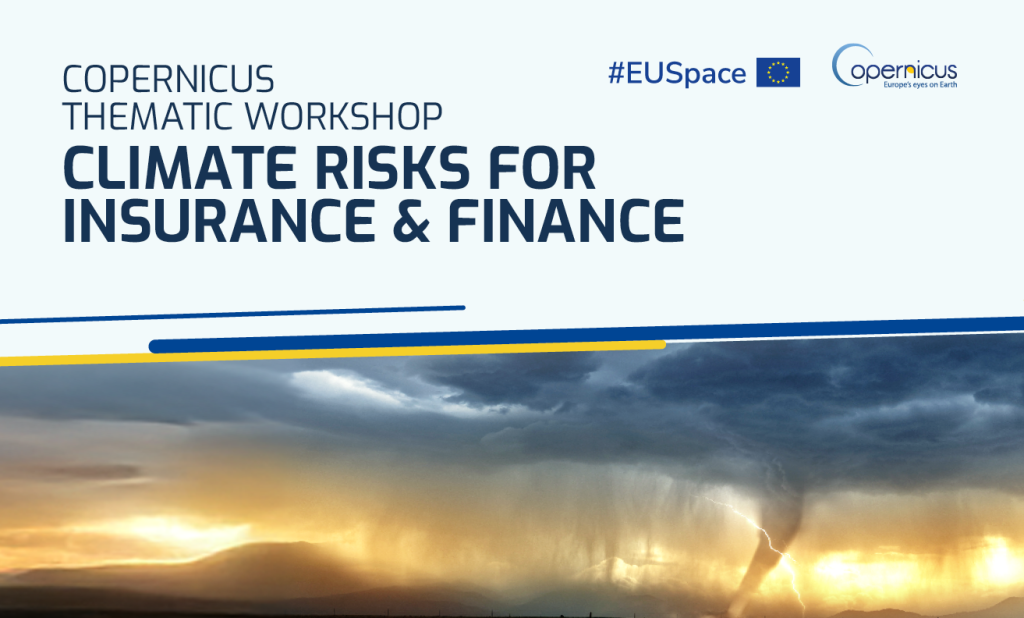
More than 300 participants from across the insurance, banking, financial services, public sector, and Earth observation communities gathered for the Copernicus Thematic Workshop on Climate Risks for Insurance and Finance to explore how Copernicus data and services can strengthen climate resilience, support regulatory compliance, and improve risk management across the financial sector.
The workshop showcased the increasing importance of Earth Observation (EO) data in addressing climate-related risks and demonstrated how Copernicus services are already helping financial institutions better understand, assess, and manage the growing impacts of climate change.
"Climate risks are no longer a future concern; they are a present-day reality for financial institutions and insurers. Copernicus provides trusted, European Earth Observation data that enables organisations to move from reactive responses to proactive risk management. Our goal is to help build a business case to transform this wealth of data into practical solutions that support resilience, regulatory compliance and informed decision-making," introduced Leila Ajjabou, Market Development Officer at EUSPA.
EO Data is becoming essential for regulatory compliance
Throughout the discussions, participants emphasized the growing importance of EO data in supporting compliance with key European regulatory frameworks, including the EU Taxonomy, the Corporate Sustainability Reporting Directive (CSRD), the Sustainable Finance Disclosure Regulation (SFDR), and the European Green Bond Standard (EuGBS).
Experts agreed that the policy landscape is increasingly moving towards embedding climate resilience by design and requiring physical climate risk data throughout the entire risk-management cycle. EO-based tools are already helping regulators and supervisors assess post-event impacts and strengthen customer protection mechanisms. A strong consensus emerged that Earth Observation data will become indispensable and non-negotiable within the next two decades, with insurers unlikely to be able to model climate-related risks effectively without it.
At the same time, participants stressed that regulation alone cannot drive adoption. EO data must also deliver tangible business value by improving productivity, supporting client engagement, and strengthening business continuity.
Copernicus Services already supporting real-world financial applications
The workshop highlighted numerous operational use cases already benefiting from Copernicus services. From land monitoring and climate change information to emergency management capabilities, Copernicus data is helping organizations monitor physical and climate risks with increasing precision.
Many financial institutions currently combine meteorological information with commercial and public EO datasets to support risk modelling and strategic planning. Banks are emerging as early adopters, using EO-derived indicators to assess hazards, exposure levels, and potential damages, enabling more effective mitigation strategies. Insurers are increasingly relying on EO data to support rapid event identification and post-disaster assessments.
Addressing remaining challenges and barriers
Despite the clear value proposition, participants identified several challenges that continue to limit broader adoption. While large volumes of EO data are available through open and free sources, gaps remain in spatial and temporal resolution for certain hazards. Flash floods were highlighted as a particular example where data availability can still be insufficient.
Financial analysts also called for simpler ways to access, combine and interpret EO information across multiple hazards and asset classes. Discussions revealed that the main challenge is no longer data availability itself, but rather the ability to transform complex EO datasets into financially defensible outputs that can be seamlessly integrated into existing workflows and decision-making processes.
Technical sessions further explored specific requirements for wildfire and flood risk modelling, while participants identified three key barriers to adoption: limited awareness and internal EO expertise, insufficient integration into operational processes, and concerns regarding costs and return on investment.
Building the roadmap for wider EO adoption
Looking ahead, stakeholders expressed strong support for expanding the use of EO data in climate stress testing, citing its ability to provide consistent, forward-looking and scenario-based risk assessments. Participants also called for greater standardisation of products and models, particularly for downscaled climate information, alongside improved data-sharing mechanisms leveraging emerging European Data Spaces.
"Europe has built world-leading Earth Observation capabilities through Copernicus and its success depends on how the products are effectively translated into operational tools. Among areas where we see great potential of evolution is the increased support to financial institutions in understanding future risks, supporting sustainable investments, and strengthening the resilience of our economy. Building user capacity and fostering innovation will be essential to achieving this goal," confirmed Mauro Facchini, European Commission Head of Unit for Earth Observation.
The workshop concluded with a clear message: while EO data may not yet be perfect in every application, it is already essential. The priority now is to accelerate the translation of raw geospatial information into practical, decision-support solutions that enable the insurance and finance sectors to navigate an increasingly climate-risk-driven future.
All the presentations are accessible on the event page.
Media note: This feature can be republished without charge provided the European Union Agency for the Space Programme (EUSPA) is acknowledged as the source at the top or the bottom of the story. You must request permission before you use any of the photographs on the site. If you republish, we would be grateful if you could link back to the EUSPA website.