The EGNOS ground segment in Torrejon de Ardoz, Spain and Ciampino, Italy is currently undergoing an important upgrade to ensure further robustness and integrity of the services to the users of Europe’s Satellite-Based-Augmentation System (SBAS).
Two out of the six challenges included in the #myEUSpace competition are targeting solutions that will power Europe’s efforts to become climate neutral by 2050.
The interactive world map is an online tool to help find information about augmentation service providers that support Galileo. By clicking on each country, the map shows the names of the Galileo-ready providers along with the name and type of service and coverage.
The Galileo-enabled autonomous parking lot solution from Estonia signed a 700.000 euro deal with Tera Ventures to scale up in Europe and the US, and to expand to road, airports, and harbours markings too.
Complementing Copernicus, Galileo, EGNOS, and the forthcoming GOVSATCOM, this new EU flagship programme, will benefit a broad range of sectors, including road and maritime transport, air traffic and control, autonomous vehicle development as well Internet of Things (IoT). It will also open up more opportunities for synergies between the already existing components of the EU Space Programme that can benefit maritime surveillance or even space situational awareness.
From the air we breathe to the water we drink and the land we grow our food on, our ecological footprint and means to minimise it are more in the focus than ever. Innovative technological solutions, including space-based applications, can help to prevent pollution and reduce its negative impacts: from agriculture to transport. To mark the European Green Week 2021, which runs from 31 May to 4 June, we look at some of the contributions that space is making to a greener future.
The European Commission’s Directorate-General for Defence Industry and Space (DG-DEFIS) has awarded two new H2020 mission evolution studies to assess how the future evolution of European GNSS (EGNSS) could be beneficial for innovative and demanding autonomous applications. The new service contract shall assess the feasibility of an integrity service complementing EGNSS High Accuracy in the 2030+ timeframe on top of the current baseline of EGNSS services to feed the evolving needs in autonomous transport.
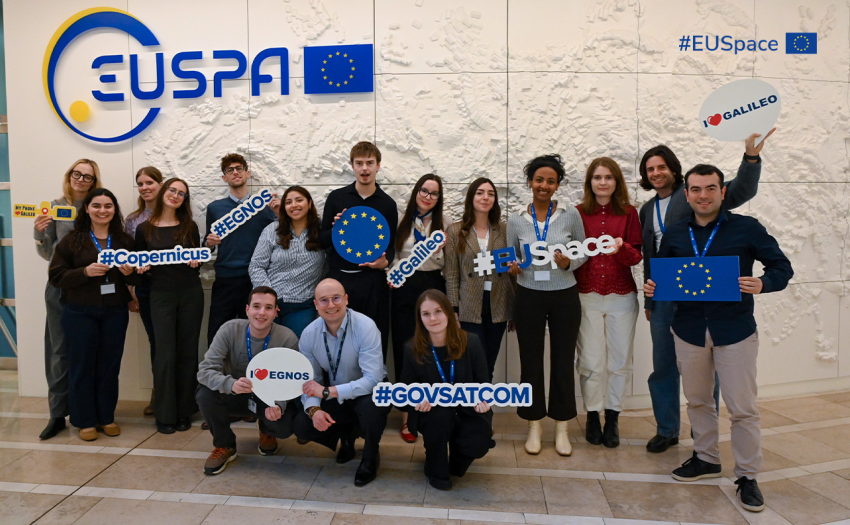
The European Union Agency for the Space Programme, EUSPA, is launched today marking the start of a new era for EU Space. Building on the legacy of the European GNSS Agency, EUSPA will take on more responsibilities to create even more opportunities from Space for EU citizens and its economy.
The European GNSS Agency (GSA) is organising a webinar on 13 April to provide information on the ‘Enhanced Galileo Green Lane - Design and Implementation’ call. Starting at 15:00 CET, the webinar will last just over an hour and will provide useful information for all parties interested in participating in this invitation to tender. For more information about the tender, click here, and to register for the webinar, click here.
The winners of the MyGalileoSolution & MyGalileoDrone were announced at Entrepreneurship Day, organised by the GSA in March 2021 to promote EGNSS-based creativity and business opportunities. The goal was also to raise awareness of the role of downstream space in achieving the EU’s common goals. The winners spoke about their experience during the competition and how it was helping to take their ideas to the next level.
The Molière project, which aims at developing innovative mobility solutions using GNSS and blockchain, is to host a virtual hackathon in Barcelona on 22-26 March targeting groundbreaking ideas to tackle the challenges faced when implementing new mobility services. Do you have an innovative idea for the mobility sector? Register here before March 22.
Point.IoT, a fast-paced programme targeting next-generation IoT solutions using Galileo, is ramping up for its second year. Like last year, the competition aims to spark creativity and problem solving among Europe’s most innovative IoT developers and entrepreneurs. Got what it takes to design the ultimate industry solution? Then click here. The deadline is 30 April 2021.
As cities strive to make their transport systems more efficient and user-friendly, they are increasingly turning to GNSS-based solutions. The Czech capital Prague, which has already leveraged GNSS to modernise its tram fleet, is now turning to a Galileo-enabled solution to improve drivers’ experience in the city’s road tunnels.
One of the main motivations behind the creation of the European Union Agency for the Space Programme (EUSPA) is to generate synergies between the different components of the EU Space Programme, particularly navigation, Earth observation and secure communications, according to European GNSS Agency (GSA) Executive Director Rodrigo da Costa.