Careers
Call for experts

EUSPA is looking for experts with professional experience in navigation satellite systems and also in specific market segments and/or with hi-tech business building skills. We are especially keen on involving business and technical experts having proved experience in one or more of the following areas:
- EGNSS signal processing,
- Development (hardware, software/firmware algorithms etc) of EGNSS receivers and antennas,
- Applications, services and products in the area of EGNSS
- EGNSS technologies state of the art boosting in particular the E-GNSS differentiators.
The call for expression of interest is permanently open (no deadline).
Experts who have already registered in the Participant Portal expert database are invited to access the following website, to declare their interest in Fundamental Elements assignments (and update their area of expertise) here.
Fundamental Elements

What is Fundamental Elements?
Fundamental Elements is an EU R&D funding mechanism supporting the development of EGNSS-enabled chipsets, receivers and antennas. The Fundamental Elements projects are part of the overall European GNSS strategy for market uptake, led by EUSPA. The objectives of the Fundamental Elements can be summarised as follows:
- Facilitating the adoption of the European GNSS Systems, building on their innovative services and differentiators;
- Improving the competitiveness of the EU industry;
- Addressing user needs in priority market segments;
- Maximising benefits to European citizens.
The total budget for all the projects, to be carried out from 2021 – 2027, is EUR 43 million.
With the new framework, there is a second round of the Fundamental Elements Programme, which will be a continuation of the previous successful one. The closer focus will be on:
- The continuity of being driven by user needs in all market segments;
- Operational implementation of current differentiators - e.g. OSNMA, HAS, triple-frequency;
- Preparing for commercial implementation of new differentiators - e.g. EWSS, SAS, ARAIM;
- Developing emerging, disruptive technologies (e.g. leveraging machine learning, artificial intelligence);
- Exploring synergies with other space systems on user technology - e.g. Copernicus, Secure Communications.
Fundamental Elements Grants
For ongoing calls for proposals within the Fundamental Elements Programme, please consult the EUSPA Grants page.
Open Grants
The following grant opportunities are currently open under the Fundamental Elements Programme:
- Galileo HAS enabled Space receiver
- Robust and professional receiver leveraging on Galileo differentiators
Complementarity with H2020 and Horizon Europe
Fundamental Elements complements the EU’s Horizon 2020 and also its successor Horizon Europe research programmes. Horizon Europe, on the one hand, aims to foster the adoption of Galileo, EGNOS and Copernicus, mostly via content and application development and supports the integration of services provided by these programmes into devices and their commercialisation. Fundamental Elements, on the other hand, focuses on supporting the development of innovative chipset and receiver technologies that the industry would not yet invest in on its own initiative, thus accelerating their integration of Galileo, EGNOS and Copernicus into market-ready devices.
Downstream Value Chain
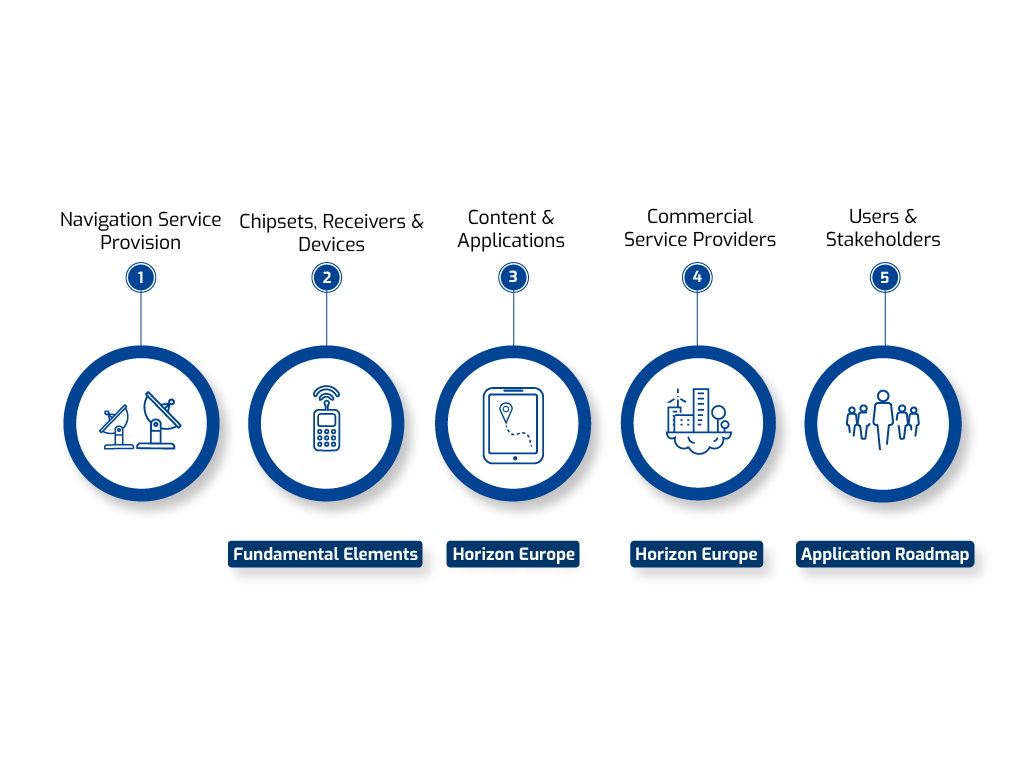
Horizon Europe

Through Horizon Europe, EUSPA stimulates the market development of the EU Space downstream sector and supports the uptake of space-based solutions. Our space calls are placed under the pillar II of Horizon Europe, where specifically Cluster 4 of the Work Programme focuses on Digital, Industry, and Space.
EUSPA’s fourth Horizon Europe call
The fourth EUSPA Horizon Europe call for proposals HORIZON-EUSPA-2026-SPACE, bringing a collective investment of 15 million EUR, is now closed.
The Call was structured in the following 2 topics.
Space Data Economy
The Space Data Economy (HORIZON-EUSPA-2026-SPACE-02-51) topic focuses on developing innovative applications that leverage Galileo, EGNOS and Copernicus data, specifically targeting four priority areas:
- clean energy solutions,
- climate adaptation and environmental footprint reduction,
- green financing and insurance services, and
- the creation of liveable, sustainable cities.
Innovative space-based applications enhancing capabilities for a resilient Europe
The Innovative space-based applications enhancing capabilities for a resilient Europe (HORIZON-EUSPA-2026-SPACE-02-52) topic aims to support the development of innovative applications that leverage Galileo, EGNOS and other EU Space Programme components, in particular Copernicus and/or GOVSATCOM, to strengthen Europe’s resilience through enhanced disaster risk management, efficient emergency response, critical infrastructure protection and secure, integrated crisis operations.
The first EUSPA Horizon Europe Call with an overall budget of 32.6 million EUR is already in the implementation phase with 13 ongoing projects that foster the European Green Deal, safeguard our society from crises and underpin Europe’s digital sovereignty. The second and third EUSPA Horizon Europe Calls mobilized an overall budget of 48.1 million EUR and 34.5 million EUR consequently, building a portfolio of projects that reinforces the international reach of European companies and support space-based applications for businesses and policymaking.
Supporting the success of the European industry
While many of these projects are still in their implementation stage, some first success cases demonstrate the outcomes of this investment. The list includes beneficiaries that managed to successfully scale and/or commercialize their prototypes, and worked in critical policy or societal challenges, advancing their technology.
Discover some of the success cases
Galileo, EGNOS and Copernicus in other non-space calls
On top of the topics managed directly by EUSPA, the use of EGNSS and Copernicus is widely anchored in concrete calls and topics within the Work Programme for 2025, with many non-space topics recommending or requiring the use of Galileo, EGNOS and Copernicus.
The topics range from health to cultural heritage, from climate change and resilience to fight against criminal activities, from mobility to big data; all areas that can strongly benefit from the space capabilities offered by EGNSS and Copernicus. A list of examples can be found here, while further details can be found in the Funding & tender opportunities portal.
Legal framework
Regulatory framework relevant to EUSPA procurement:
GSA Financial Rules and Rules of Application, in practice, referring to:
- Regulation (EU, Euratom) 2018/1046 of the European Parliament and of the Council of 18 July 2018 on the financial budget of the Union, amending Regulations (EU) No 1296/2013, (EU) No 1301/2013, (EU) No 1303/2013, (EU) No 1304/2013, (EU) No 1309/2013, (EU) No 1316/2013, (EU) No 223/2014, (EU) No 283/2014, and decision No 541/2014/EU and repealing Regulation (EU, Euratom) No 966/2012;
- Regulation (EU) 2019/715 of 18 December 2018 on the framework financial regulation for the bodies set up under the TFEU and Euratom Treaty and referred to in Article 70 of the Regulation (EU,Euratom) 2018/1046 of the European Parliament and of the Council;
- Regulation (EU) 2021/696 of the European Parliament and of the Council of 28 April 2021 establishing the Union Space Programme and the European Union Agency for the Space Programme and repealing Regulations (EU) No 912/2010, (EU) No 1285/2013 and (EU) No 377/2014 and Decision No 541/2014/EU.
EUSPA Tenders European Court of Justice Ombudsman Register of Documents
PKI (Public Key Infrastructure)
What is PKI?
A Public Key Infrastructure (PKI) is a set of hardware, software, people, policies and procedures needed to create, manage, distribute, use, store and revoke digital certificates.
A digital certificate is an electronic data structure that binds an entity, being an institution, a person, a computer program, a web address, etc. to its public key. Digital certificates are used for secure communication based on asymmetric cryptography.
EUSPA PKI
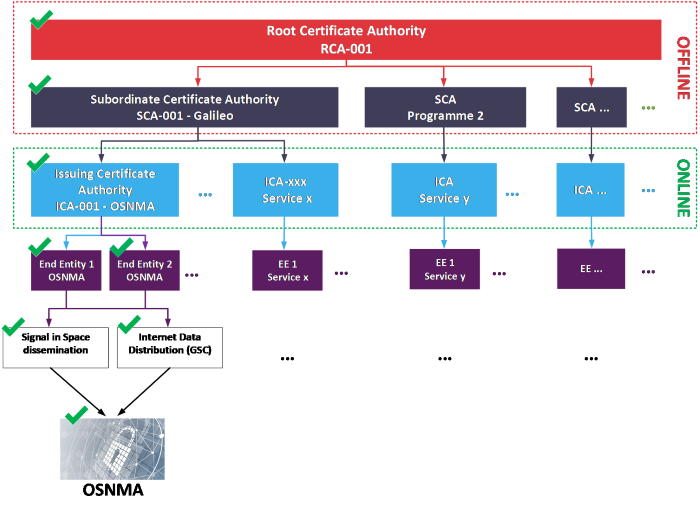
The PKI implemented in EUSPA is organized as a 3-tier hierarchy of Certificate Authorities in order to support the future needs of the EU Space Programme. A Certificate Authority (CA) is an entity that signs and issues digital certificates. The Root CA (RCA) is the Root of Trust of the PKI hierarchy. The Subordinate CA (SCA) is an intermediate authority used at the Programme component level (e.g: Galileo). The Issuing CA (ICA) is the instance responsible for certificate management at service level (e.g: OSNMA).
EUSPA PKI is used as part of the OSNMA Initial Service provision phase. The PKI provides digital certificates to verify the authenticity of the public cryptographic elements needed to verify the authenticity of the OSNMA data coming from the Signal in Space, the ultimate goal of the OSNMA.
The authentication of the OSNMA data coming from Signal in Space (SiS) relies on the provision of the public cryptographic elements through the internet data distribution service hosted by the European GNSS Service Centre (GSC). Updates of part of the cryptographic elements are also sent through the SiS. The PKI provides digital certificates organized hierarchically allowing OSNMA users to control the authenticity of the public cryptographic elements. This capability to control the end-to-end authenticity from the End Entity certificate to the Root CA is the implementation of the chain of trust.
See also:
EUSPA quality policy
The EUSPA Quality Policy defines the long-term quality strategy of the Agency that is aligned with its purpose, mission, and strategic direction as expressed through the Agency Mission Statement.
By abiding with the emphasis on the customer within ISO9001:2015 Leadership and Commitment, the Agency applies a customer-centric approach in the expression of its Quality Policy to all of its Interested Parties and refers to them in the Quality Policy as Agency Customers.
The Agency Quality Policy formulates the following quality objectives for the Agency:
- Ensure that the needs and expectations of the Agency Customers are known and understood, with the target of meeting them by the provision of high-quality products, data and services delivered through the EU Space Programme;
- Managing the provision of and ensuring the continuity of current EU space initiatives and programme components, aiming for Customer satisfaction in the most cost-efficient manner;
- Achieve the strategic objectives of the Agency by meeting the evolving Customer needs and priorities through clearly established improvement policies leading to full adoption of information and services available through the European GNSS and Earth Observation systems and future components of the Space Programme;
- Monitor and control of Agency processes by setting up and maintaining the Integrated Management System (IMS) that embeds the high level of quality into Agency activities and outputs to ensure the security, continuity, safety and robustness of European space-based services;
- Guarantee that the Agency and the IMS operate in compliance with the applicable regulatory and standards environment to the maximum effectiveness and efficiency;
- Evolve the IMS to continuously meet the Agency’s needs, by regularly evaluating data generated in the operation of the IMS and from other sources, systematically evaluating performance and other data by establishing Internal Quality Audits based on risks.
See Also
EMAS
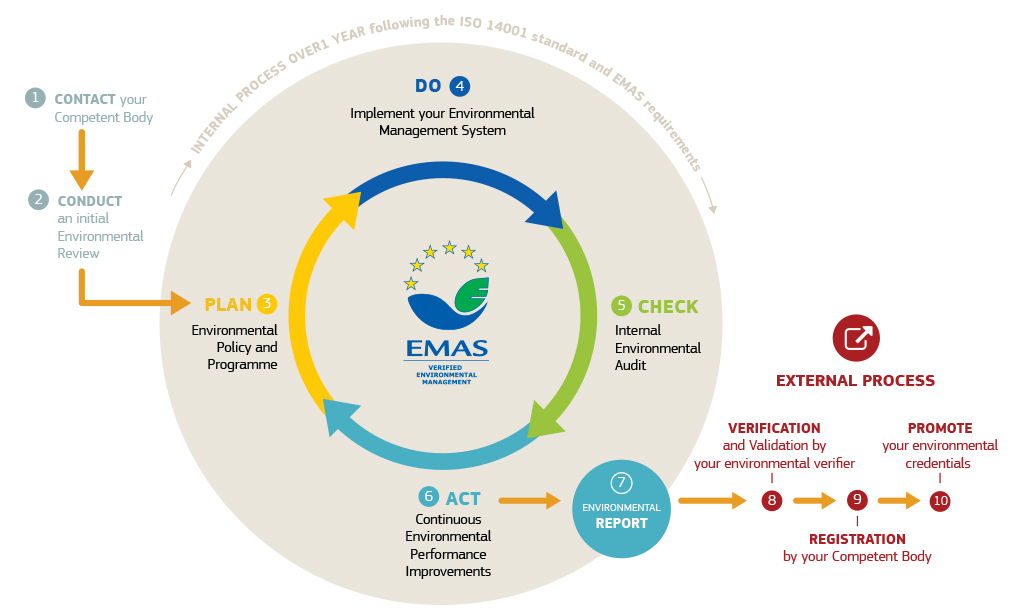
In the light of EUSPA’s mission and vision, and as part of the Financial Framework Partnership Agreement (FFPA) EUSPA is collaborating with the EC and ESA to jointly define modalities to reach the European climate neutrality goal by 2050, and cooperating on activities contributing to this target.
In accordance with Article 30 of the FFPA, EUSPA has adopted an environmental policy, and its environmental management system, which includes also an environmental statement, is certified under the Eco-Management and Audit Scheme (EMAS).
EU Space SAB
The Security Accreditation Board (SAB) plays a pivotal role as the security accreditation authority for the entire EU Space Programme and all its components: Copernicus, EGNOS, Galileo, GOVSATCOM, IRIS2, and SSA.
In this capacity, it ensures that the security risks are known, and security measures are defined to reduce such risks to an acceptable level, given the security needs of the Union and its Member States.
Within the SAB, Member States make accreditation decisions independently from the European Commission, EUSPA and ESA to approve for instance the satellite launches, the systems updates and their operations and the services. It corresponds to around 200 decisions per year.
The SAB has also the duty to advise, within its field of competence, the European Commission on the production of the General Security Requirements of the different EU Space Programme components.
The SAB is supported by Member States and the Security Accreditation Department (SADEP).
The Security Accreditation Department (SADEP) within the EUSPA organization exclusively serves the Security Accreditation Board (SAB), with its staff reporting directly to the SAB chairperson, who exercises appointing authority to uphold their independence. The SADEP staff, coming from all over the EU, perform counting security assessments, inspections, or audits, including cyber audits and cyber penetration tests.
In fulfilling its responsibilities, the SAB may need to enter into cooperation agreements, such as the one established with EASA in 2023 concerning EGNOS. These agreements serve to coordinate certification and accreditation activities effectively.