IRIS²
The IRIS2 (Infrastructure for Resilience, Interconnectivity and Security by Satellite) constellation is the European Union’s answer to pressing challenges ahead, offering enhanced communication capacities to governmental users, businesses, while ensuring high-speed internet broadband to cope with connectivity dead zones. The need for a secure and resilient global connectivity increases with the digitisation of the economy and society, and the increasing geopolitical and cybersecurity threats.
This multi-orbital constellation will combine the benefits offered by Low Earth (LEO), Geostationary (GEO), and Medium Earth Orbit (MEO) satellites. It is set to provide secure communication services to the EU and its Member States as well as broadband connectivity for European citizens, private companies and governmental authorities. IRIS2 will put an end to dead zones in Europe as well as the whole of Africa using the constellation's North-South orbits through a resilient and ultra-secure space and ground-based system.
The system will support a large variety of governmental applications, mainly in the domains of surveillance (e.g. border surveillance), crisis management (e.g. humanitarian aid) and connection and protection of key infrastructures (e.g. secure communications for EU embassies).
The system will facilitate a wide array of mass-market applications, including mobile and fixed broadband satellite access, satellite trunking for B2B services, and satellite access for transportation networks. It will bolster connectivity through reinforced networks by satellite, enabling satellite broadband and cloud-based services to thrive.
Relying on quantum cryptography through the European Quantum Communication Infrastructure (EuroQCI), and enhanced cybersecurity through a secure-by-design approach for the infrastructure, the system will bring an unprecedented security level to its users.
EUSPA is already actively involved in building secure satellite communication infrastructure for Europe through the coordination of the first phase of GOVSATCOM on which IRIS2 will be based.
GOVSATCOM
The European Union Governmental Satellite Communications (GOVSATCOM) programme aims to provide secure, resilient and cost-efficient satellite communications capabilities to security and safety critical missions and governmental operations managed by the EU and its Member States, including national security actors and EU Agencies and institutions.
Supporting EU Space Policy
GOVSATCOM is a user-centric programme with a strong security dimension.
GOVSATCOM is one of the elements of the Global Strategy for the European Union's Foreign and Security Policy of June 2016. The Programme will contribute to the EU’s response to specific threats and will provide support to the EU Maritime Strategy and the EU Arctic Policy.
Three main use cases:
- Crisis management, which may include civilian and military by common security and defence missions and operations, natural and man-made disasters, humanitarian crises and maritime emergencies.
- Surveillance, such as border and maritime surveillance or surveillance of illegal trafficking.
- Key infrastructures, e.g. Institutional Communications, various types of Critical Infrastructure, including Transport as well as EU space infrastructures such as Galileo and EGNOS.
Building the GOVSATCOM programme
The implementation of the GOVSATCOM component of the EU Space Programme started in 2021, under the new EU Space Programme Regulation.
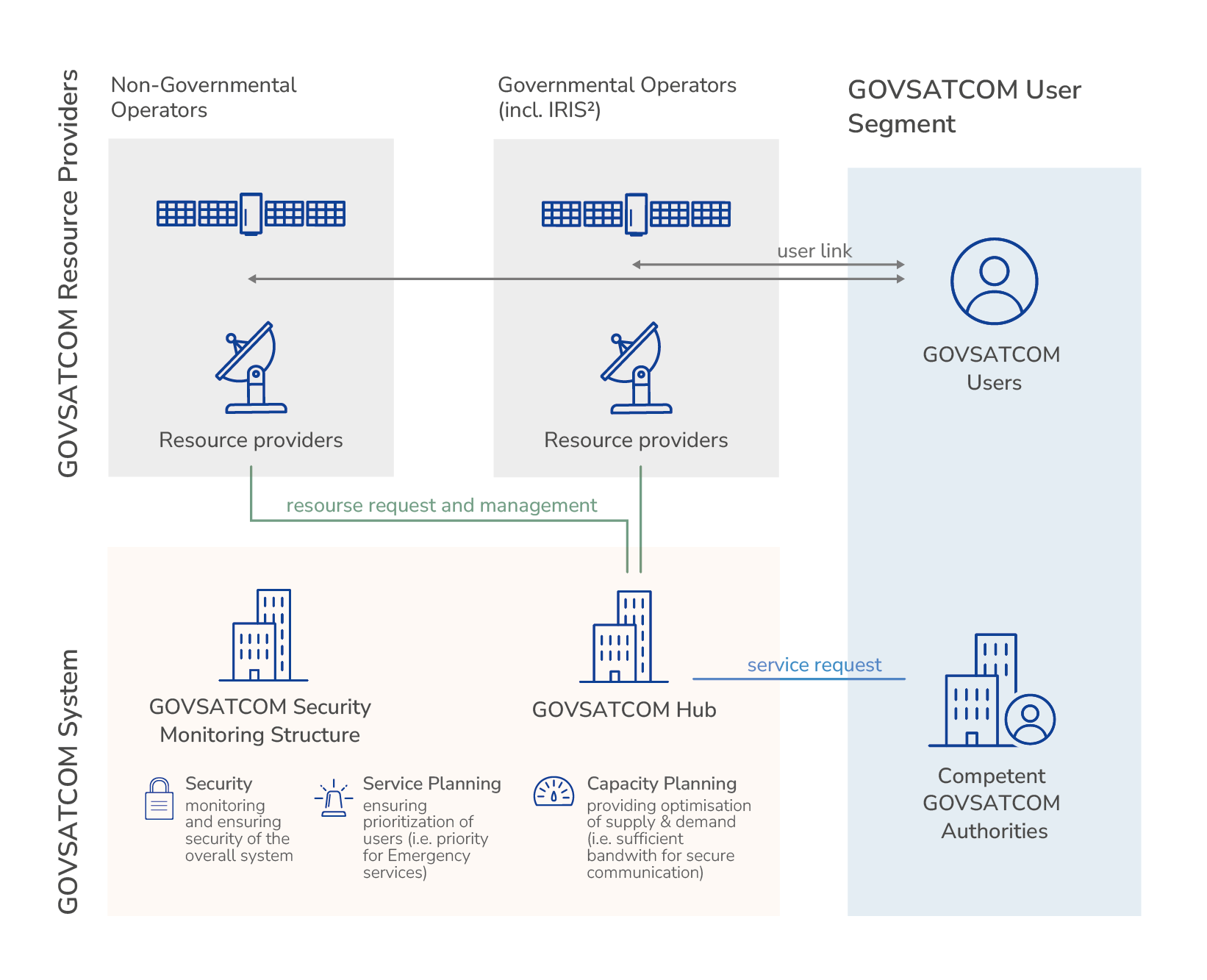
The GOVSATCOM programme is being established by pooling the capacity of governmental and commercial satellite communication providers and sharing that capacity with authorised governmental users. EUSPA has been entrusted with preparatory activities, including the establishment, growth, coordination and management of the network of future EU GOVSATCOM users, with the aim to build a solid user perspective to build the GOVSATCOM mission upon.
The network, developed under ENTRUSTED Horizon Europe project, counted 25 organisations, including Member States and EU Agencies. Led and coordinated by EUSPA, the network compiled and understood user needs and defined a detailed roadmap for developing innovative GOVSATCOM user technology.
EUSPA is also working to help define the security baseline of the programme, which will be essential to ensuring that GOVSATCOM adequately meets the security needs of its users. Furthermore, the agency is defining the architecture for the programme’s secure ground infrastructure, known as the GOVSATCOM Hubs.
Explore the GOVSATCOM Hub infographic
GOVSATCOM Hub
Meeting user needs
The GOVSATCOM services shall meet the needs of authorised users charged with the supervision and management of security-critical missions and operations. For this class of users, SATCOM security must be commensurate with the level of acceptable risks when using the service. This, for example, includes:
- Assurance that the GOVSATCOM service or resources are guaranteed and cannot be pre-empted by non-governmental users or third parties
- Resilience against jamming and interference
- Protection against interception and intrusion
- Protection against cybersecurity threats
- Non-dependence on third parties
What is Secure SATCOM?
Secure Satellite Communications (SATCOM) ensures that end-to-end satcom communications are protected and monitored following the highest resilience, integrity, availability and reliability standards. SATCOM capabilities embedded with added protection mechanisms (Secure SATCOM) offer an additional layer of resilience, along with robust security features, to guarantee assured access by authorised users only no matter where the service or mission takes place, and whether mobile or fixed.
Secure SATCOM uses a combination of satellites and ground stations to transmit and relay information from one user to another. However, they are designed with enhanced security features at space and ground levels to protect sensitive information and ensure integrity, protection and availability at the highest levels to ensure the most trustable end-to-end communications in the most critical situations.
By providing highly secured two-way reliable, accessible and guaranteed satellite communication capacity and services, Secure SATCOM enhances protection against interference, interception and intrusion – critical for the daily services of the EU economy in many vertical markets as well as in the domains of defence, security, humanitarian and emergency response and diplomatic related communications where this Secure SATCOM layer is essential in particular in crisis situations.
EU SST
What is Space Surveillance and Tracking?
More than 1 million pieces of space debris larger than 1 cm are orbiting the Earth. With 20,000 new satellites expected to be launched over the next decade, this number will increase – as too will the risk of collision in space.
Such a collision could severely damage a satellite, or even destroy it, either of which would result in significant disruptions to services.
To mitigate the risk of a collision between space assets – including with Galileo, EGNOS, Copernicus and GOVSATCOM satellites – and other spacecraft and debris, in-orbit fragmentations and uncontrolled re-entries of space objects, the EU established the Space Surveillance and Tracking (EU SST) sub-component of the SSA Programme.
EU SST safeguards space assets, especially EU Space Programme satellites, along with the space assets of EU Member States and other space operators. It uses a network of ground-based sensors capable of surveying and tracking space objects, together with processing capabilities aimed at providing data, information and services on space objects orbiting the Earth.
EU SST currently provides three services:
- Collision Avoidance (CA): Assesses risk of collision between satellites or between satellites and space debris and generates collision avoidance alerts.
- Re-entry Analysis (RE): Assesses risk of uncontrolled re-entry of space objects into the Earth’s atmosphere and generates related information.
- Fragmentation Analysis (FG): Detects and characterises in-orbit fragmentations, break-ups or collisions, and analyses all available information regarding the object(s) involved in the event.
More than 300 organisations currently receive these services and more than 600 satellites are safeguarded from the risk of collision.
For the implementation of EU SST, established in 2021 as a sub-component of the EU Space Programme, the EU SST Partnership of 15 EU Member States (Austria, Czech Republic, Denmark, Finland, France, Germany, Greece, Italy, Latvia, the Netherlands, Poland, Portugal, Romania, Spain and Sweden) together with EUSPA acting as the EU SST Front Desk form the EU SST Cooperation.
EU SST is the key operational capability for the EU’s approach to Space Traffic Management (STM). In this regard, EU SST is continuously improving its core capabilities and developing new technologies to face challenges raised by an increasingly congested space environment, relying as much as possible on the European SSA commercial ecosystem.
EU SST leaflet EU SST facts and figures EU SST Service Portfolio
EUSPA’s role
EUSPA has been responsible for the EU Space Programme’s SST Front Desk operations since 1 July 2023. The responsibility was transferred from the European Union Satellite Centre (SatCen) to EUSPA’s Galileo Security Monitoring Centre (GSMC) in Madrid.
The operational information is built by the EU SST Partnership, from the SSA assets and national operations centres that are owned by its Member States.
The Front Desk is the main interface for delivering SST information and services between the EU SST Partnership and the user community, including activities related to user coordination, service performance, engagement and communication.
In addition to its SST Front Desk responsibilities, EUSPA is contributing to the system’s security monitoring, particularly establishing the security requirements needed to shape the SST network in support of the European Commission and the EU SST Partnership.
What is SSA?
Space Situational Awareness (SSA) is an essential component of the EU Space Programme. It means a holistic approach, including comprehensive knowledge and understanding of the main space hazards, encompassing collisions between space objects, fragmentation and re-entry of space objects into the atmosphere, space weather events, and near-Earth objects.
SSA plays a key role in ensuring the safety and security of the European economies, societies and citizens who rely on space-based applications for communication, navigation and observation.
Mitigating the risk of collisions
One of the core functions of SSA is to mitigate the risk of a collision between satellites and space debris, a process called Space Surveillance and Tracking (SST).
An SST system uses a network of ground- and space-based sensors and other infrastructure to survey, track and protect space objects orbiting Earth.
EU Space ISAC
In 2022, EU leaders identified space as a strategic domain in the Strategic Compass and called for an EU Space Strategy for Security and Defence. Building on this political momentum, the Commission and the High Representative have developed the first-ever EU Space Strategy for Security and Defence.
In the current geopolitical context of increasing power competition and intensification of threats, the EU is taking action to protect its space assets, defend its interests, deter hostile activities in space and strengthen its strategic posture and autonomy.
In the light of this, the European Commission and EUSPA are spearheading the formation of the EU Space Information Sharing Centre (ISAC). This network-based information-sharing platform promotes collaboration, awareness and best practices among private entities to ensure the safety of our space systems and the networks they rely on.
Founding Members
Members
Call for Interests Timeline
The calls are open until 31 December 2025, with cut-off dates on:
- 31 May 2025
- 31 December 2025
Please read the full text of the Call of Expression of Interest before applying, especially to understand expectations towards Founding Participants and to be aware of eligibility criteria.
Applications shall be submitted by filling in the appropriate Application form, in English, by an applicant’s authorised representative (e.g. power of attorney, entity’s extract from commercial registry, etc.). The Application form is available here.
The EU Space ISAC is established by the EC, with support of EUSPA, under the umbrella of the EU Space Strategy for Security and Defence (EUSSSD), aligning with other EU security initiatives such as the Network and Information Security (NIS) 2 Directive and the Critical Entities Resilience (CER) Directive.
* The EU Space ISAC is not an incident response body. Each member remains responsible for their security incident responses
Operational security
Operational security is at the heart of EUSPA. It involves implementing robust measures to safeguard sensitive information, assets and operations. It is essential to ensure the confidentiality, integrity and availability of EU space-related assets.
By employing advanced encryption protocols, access controls and cybersecurity frameworks and establishing risk assessment procedures to enhance preparedness and resilience against potential security threats or disruptions, operational security helps mitigate risks associated with unauthorized access, data breaches and cyber threats. It also involves implementing physical security measures to protect infrastructure, facilities, and equipment critical to space operations.
By prioritizing operational security, the EU Space Programme can maintain trust, reliability, and continuity in its space-related endeavours, fostering innovation and collaboration in the space domain.
EUSPA is responsible for the operational security of Galileo and EGNOS. The Agency is therefore carrying out risk and threat analysis and all the necessary activities to ensure and monitor the security of these components, in particular setting of technical specifications and operational procedures, and monitor their compliance with the general security requirements referred to in the EU Space regulation. It is ensured through various departments of the agency:
The Security Operations and Monitoring Department, managing the Galileo Security Monitoring Centre (GSMC), the Security Authority Department and the Engineering Department, in support to the Galileo and EGNOS Departments.
In conclusion, operational security is not just a priority but a fundamental imperative at EUSPA.
GNSS and Secure SATCOM Reports
The EU needs independent, secure, resilient and high-speed space-based connectivity to satisfy the needs of EU institutions, bodies, agencies and Member States. Secure SATCOM provides one or two-way real-time, reliable, accessible and guaranteed satellite capacity/service for communications.
EUSPA’s GNSS and Secure SATCOM User Technology and the Secure SATCOM Market and User Technology reports provide insights into the technology features and trends of both GNSS and secure SATCOM domains and their possible synergies.
GNSS and Secure SATCOM User Technology Report
The first GNSS and Secure SATCOM User Technology Report builds upon the legacy of three previous issues of GNSS User Technology reports and the Secure SATCOM Market and User Technology Report. It addresses both the GNSS and Secure SATCOM domains, with the first two main sections providing insights into their technology and trends.
The third and final section is devoted to the Editor’s special focus on synergies between these domains, including Earth Observation where relevant.
Secure SATCOM Market and User Technology Report
The publication Report provides insights into the varied contributions of Secure SATCOM across a range of governmental applications. These applications are organised into three use case categories:
- Surveillance;
- Crisis Management and;
- Key Infrastructure.
Collectively, the report explores a total of 13 comprehensive individual use cases. Unless specified, the report addresses aspects related to the secure SATCOM Market and User Technology in the EU, though some considerations (e.g. economic and technological trends) also apply at a global level.
GNSS and EO Market Report
The EO & GNSS market report is a comprehensive source of knowledge and information on the dynamic, global EO & GNSS market. This report is periodically updated and released every two years to reflect the latest trends, developments, and innovations in the fields essential to the users of the EO and GNSS technologies.
The report categorizes applications into several market segments, addressing diverse stakeholders ranging from citizens and businesses to governments, industries, international organisations, NGOs, and researchers. General overview of the EO and GNSS market introduces an overview of the downstream space application market, main EO and GNSS trends, market size and revenues of both EO and GNSS (as well as shipments and installed base in the case of GNSS). A global industry overview, main trends, and a general description of what Copernicus and EGNSS encompass are then explained. Finally, it presents how EO and GNSS play a role across general policy and market trends.
The 2024 edition presents 15 market segments. The Editor’s Special explores how EU Space, particularly EGNSS and Copernicus, contribute to building a more resilient society – a timely topic considering today’s global context of rapid technological advancement, climate-related changes and ongoing geopolitical tensions.
As showcased throughout the report, the flagship components of the EU Space Programme covered in this report, Galileo, EGNOS, and Copernicus are key enablers in the downstream space application market. The added value and key differentiators of European GNSS and EO are showcased across each market segment displayed in this report, separately and in synergy.
For main findings and market values, please read the executive summary.
Methodology and sources of information
The Market Report applies the EUSPA’s Market Monitoring and Forecasting Tool (MMFT). The model utilises advanced forecasting techniques applied to a wide range of input data, assumptions, and scenarios to forecast the size of the GNSS and EO markets. The GNSS market is quantified according to shipments, revenues and installed base of GNSS devices, while the EO market is defined by purchase of data and services. All revenues are measured from the demand point of view, i.e., in which part of the world the data, services, and devices are purchased. This methodology attributes the size of the EO and GNSS market to the region where, devices, data or services are sold and used. For more details on the methodology and sources of information go to Annex 1.
Disclaimer
The EUSPA EO and GNSS Market Report issue 2 was carried out by the European Union Agency for the Space Programme in cooperation with the European Commission and with the support of EY Belgium, Egis, Evenflow, FDC and LE Europe.
The present document is being distributed without warranty of any kind, either express or implied in relation to its content and/or use and the views expressed herein do not necessarily represent the opinions or the stated policy of either EUSPA or the European Union. To the extent permitted by the applicable law, the EUSPA shall not be liable for any damages arising from the content and use of the present document.
Any comments to improve the next issue are welcome and should be addressed to: market@euspa.europa.eu
Working at EUSPA
Diverse, inclusive and respectful environment

Diversity is one of our core values. As an EU Agency, we endeavour to foster a diverse and inclusive talent pool and provide equal opportunities for all.
The EUSPA Diversity and Inclusion Strategy and Action Plan was adopted in June 2023. The Agency is also a signatory of the EUAN Charter on Diversity and Inclusion.
We are committed to preventing and condemning any form of harassment through its policy on protecting the dignity of the person and preventing psychological and sexual harassment. An active network of Confidential Counsellors and awareness campaigns are fundamental elements for this.
Onboarding and induction
The onboarding phase begins as soon as the offer letter is accepted. We support our newcomers with pre-recruitment requirements and guide them through the necessary documents and processes. These include pre-recruitment medical visits, preparation of employment contracts, and establishment of financial rights and entitlements.
Newcomers receive clear instructions for their first day and an outline of onboarding meetings scheduled for the initial weeks. Our induction process is designed to help new team members smoothly integrate into the team, settle into their roles, and become familiar with the operational procedures and the Agency's culture.
Once the start date arrives, we support our staff in settling into their new workplace, ensuring they can fully focus on their role. During the entire onboarding process, newcomers stay connected with the HR team and have a dedicated HR contact for any assistance they need.
Social life and wellbeing
Outside activity and management of conflict of interest
The EU public servants are governed by the Staff Regulations and the Conditions of Employment of the Servants. All EUSPA staff members wishing to engage in additional outside activities, while in active service or after leaving EU Public service, shall first obtain the approval of the Executive Director or the Security Accreditation Board Chairperson.
An outside activity while in active service means any activity, paid or unpaid, that:
- is not part of the staff member’s duties at the Agency and;
- cannot reasonably be considered a hobby or leisure activity.
At a practical level, such an outside activity while in active service should not:
- be so time-consuming as to impact negatively on their work at the Agency or constitute a job in itself;
- give rise to any possible appearance of a conflict of interest or be in some other way discreditable, to risk bringing the Agency into disrepute;
- the amount of net remuneration should not be more than €10.000 per calendar year;
- no outside work may be performed either on the premises of the Agency or during normal working hours.