The European GNSS Agency’s (GSA) User Technology Report 2020 is on the horizon. In this issue, the Report will present an overview of the current GNSS user technology trends and developments across four macrosegments: high volume devices, safety- and liability-critical devices, high-accuracy devices, timing devices.
The European Commission’s Directorate-General for Defence, Industry and Space (DG-DEFIS) has awarded two new H2020 mission evolution studies to assess the feasibility of an EGNSS-based safety service for the rail sector beyond 2022, which would enable to rationalise the rail signalling infrastructure.
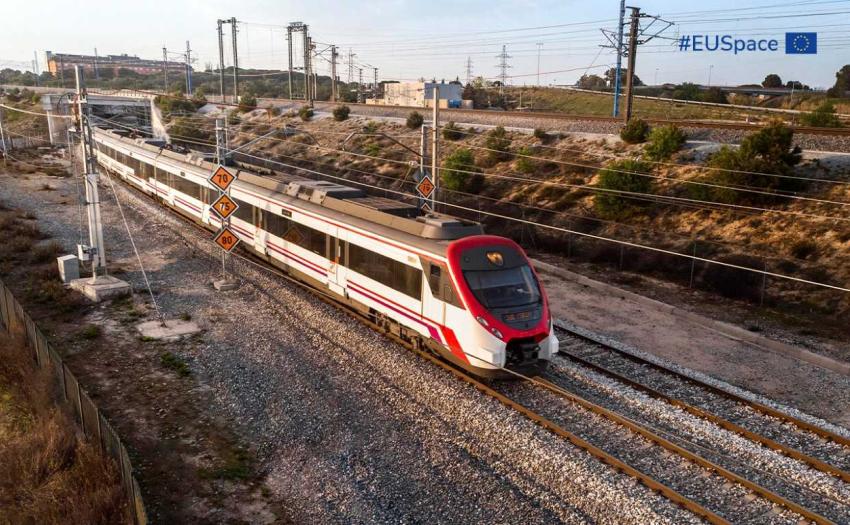
For the first time in Europe, the Italian Railway Network (RFI) has introduced a new railway traffic control and management system that uses satellite technologies, including Galileo.
The European Commission’s Directorate-General for Defence, Industry and Space (DG-DEFIS) has issued a Prior Information Notice (PIN) for a planned call to address how the future evolution of European GNSS (EGNSS) could be beneficial for autonomous transportation. The new service contract shall assess the feasibility of an integrity service complementing EGNSS High Accuracy in the 2030+ timeframe.
A Work Plan for the European Railway Traffic Management System (ERTMS), published by the European Commission in May this year, lists satellite positioning as one of the game changing technologies underpinning future evolutions of the system and a key element to be included in future Technological Specifications for Interoperability (TSI).
By reinforcing synergies with other space technologies and working with all the Member States, while creating a favourable ecosystem, the impact of the space sector on economic growth in Europe will expand and create more jobs, according to European GNSS Agency (GSA) Acting Executive Director Pascal Claudel.
The Prague Public Transit Company (DPP) has issued a tender for Galileo-enabled receivers to be included in Prague tramways as part of a modernization plan to increase network efficiency and improve user experience.
Carlo des Dorides took up his position as executive director of the European GNSS Agency (GSA) on February 1, 2011. In the nine years since then, the Galileo programme has progressed from a project on paper to an operational programme with over a billion users around the globe. As his term at the helm of the Agency draws to an end, the GSA executive director looks back at the successes and challenges of the past nine years and speaks about his hopes for the future.
The European Commission’s Directorate-General for Internal Market, Industry, Entrepreneurship and SMEs (DG GROW) has issued an Invitation to Tender (ITT) for a planned call for a new service contract to assess the feasibility of an EGNSS-based safety service for the rail sector beyond 2022 which would enable the rationalisation of rail signalling infrastructure.
This has been a year of tremendous growth for the GSA, Galileo, EGNOS and the European Space Programme as a whole. We hit the ground running in 2019, buoyed by a wave of optimism following the successful European Space Week, held in in Marseille last December.
The European GNSS Agency (GSA) has released updates to its Reports on User Needs and Requirements. This series of reports is compiled following a systematic process of consultation with the community of users of position, navigation, and time services and technologies. Thanks to these consultations it is possible to take users’ needs and requirements into account in the short and long-term evolution of European GNSS.
The European Commission’s Directorate-General for Internal Market, Industry, Entrepreneurship and SMEs (DG GROW) has issued a Prior Information Notice (PIN) for a planned call for a new service contract to assess the feasibility of an EGNSS-based safety service for the rail sector beyond 2022 which would make it possible to rationalise rail signalling infrastructure.
New technologies that offer safety and efficiency benefits will define the rail system of the future. GNSS is one such technology and is already being used to track rolling-stock, and in passenger information, traffic management and predictive maintenance systems. In his speech at the ERTMS conference #CCRCC2019 “The Engine for the Digital Future,” European GNSS Agency (GSA) Executive Director Carlo des Dorides outlined how his Agency is working with the rail sector.
It’s that time of year again. Preparations are already well underway for European Space Week 2019, which this year will take place at the Helsinki Congress Paasitorni in the Finnish capital on December 3-5. The week will be packed full of exciting events ranging from keynotes, discussions and conference sessions, to the E-GNSS User Assembly, a festive awards ceremony and much more.
The sixth issue of the GNSS Market Report from the European GNSS Agency (GSA) has been downloaded over 1,000 times since it was published on the GSA website on October 15. With its comprehensive overview of the current status and future trends on the global GNSS market, the report was eagerly awaited by all market players, from global corporations and SMEs to R&D organisations and academia.